
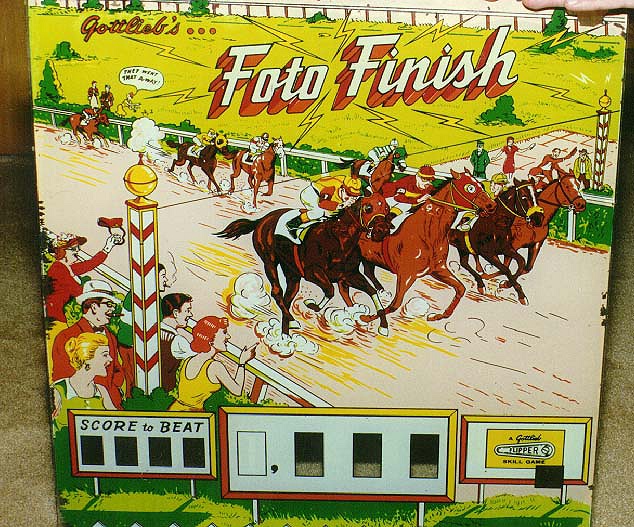
Foto Finish, released by Gottlieb in 1961, remains a quintessential example of Wayne Neyens’ mid-century design philosophy and Roy Parker’s iconic aesthetic. This single-player electromechanical machine transports the player to the track, leaning heavily into the horse racing theme that dominated the era’s arcade landscape. While it lacks the frenetic pace of modern digital displays, the game relies on a classic mechanical layout featuring two flippers, a pair of pop bumpers, and seven passive bumpers that act as chaotic obstacles, forcing the ball into unpredictable trajectories across the playfield.
The board’s geometry is deceptively simple, centered around the interplay between the two slingshots and the infamous gobble hole—a feature that often acts as the final arbiter of a player’s score. The inclusion of a rollunder and two strategic standup targets provides just enough precision to keep the game from feeling like a pure game of chance. With only 1,000 units ever produced, Foto Finish is a rare slice of arcade history that rewards players who can master the nudging techniques necessary to navigate the passive bumper field. It is a masterclass in minimalist design, proving that a well-placed gobble hole and a pair of flippers are all you need to capture the high-stakes tension of a day at the races.