
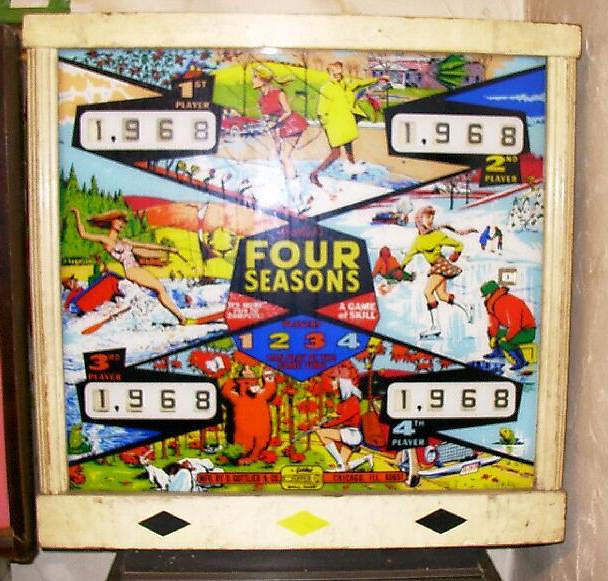
Four Seasons, released by Gottlieb in 1968, stands as a quintessential example of Ed Krynski’s design mastery during the golden age of electromechanical machines. With vibrant, nostalgic artwork by Art Stenholm, the game celebrates the cyclical joy of the outdoors, spanning everything from water skiing and summer recreation to the crisp stillness of ice skating and hunting. It is a four-player classic that relies on the clean, rhythmic feedback of mechanical reels rather than digital spectacle, offering a tactile experience that rewards precise aim and patient ball control.
The playfield layout is deceptively open, anchored by a unique array of seven kick-out holes that demand consistent accuracy to keep your score climbing. Rather than relying on modern ramps or magnets, Krynski utilized a pair of rotating arrow bumpers that shift the game’s flow, forcing players to adapt their strategy as the target zones evolve. With three pop bumpers and two strategic standup targets, the machine generates a frantic, high-energy pace, especially when navigating the dual outlanes that flank the lower playfield, which can quickly turn a promising round into a sudden drain.
Mastering Four Seasons requires a disciplined approach to the kick-out holes; because they are scattered throughout the board, players must treat each one as a distinct mini-objective to maximize point accumulation. The interplay between the rotating bumpers and the kick-outs creates a constant tug-of-war for the player’s attention. With only 1,500 units produced, this machine is a genuine collector’s piece that perfectly captures the charm of mid-century arcade design, proving that you don’t need complex toys to create a challenging and deeply satisfying pinball session.