
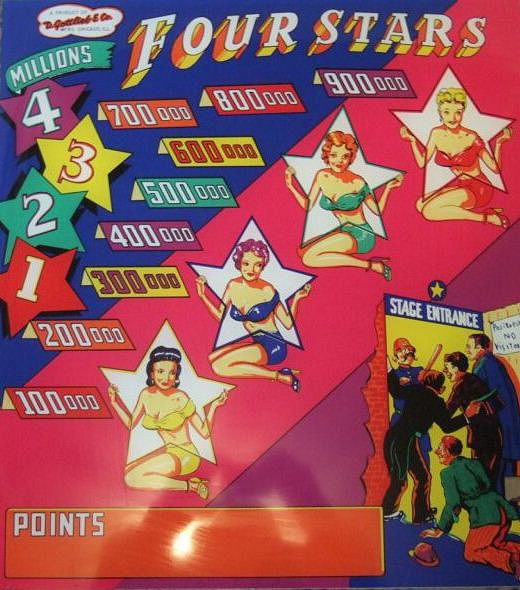
Four Stars, released by Gottlieb in 1952, stands as a quintessential artifact of the early electro-mechanical era, showcasing the collaborative genius of legendary designer Wayne Neyens and artist Roy Parker. While modern tables often lean on complex ramps and interactive toys, Four Stars relies on the elegant, pure geometry of a four-flipper layout to challenge the player. Parker’s signature aesthetic brings a classic mid-century charm to the playfield, framing a game that feels both intimate and deceptively difficult as you navigate its symmetrical architecture.
The mechanical heart of the machine revolves around its quartet of trap holes, which serve as the primary objective for any high-scoring run. With four pop bumpers providing unpredictable kinetic energy, the ball rarely stays still, forcing players to master precise flipper timing to guide the ball into these high-value pockets. The layout demands a rhythmic, deliberate style of play; because the machine lacks the multi-ball chaos of contemporary titles, success is entirely dependent on your ability to control the flow and trap the ball for accurate shots.
For those looking to conquer this classic, the key is consistency. Given the limited production run of just 950 units, the machine remains a prized piece of history for collectors who appreciate the tactile, responsive nature of early Gottlieb engineering. Strategy here is stripped down to its most rewarding form: focus on mastering the rebound angles off the slingshots and pop bumpers to feed your flippers cleanly. It is a masterclass in minimalism, proving that even seven decades later, four flippers and a handful of trap holes can provide a thrill that holds its own against any modern digital spectacle.