
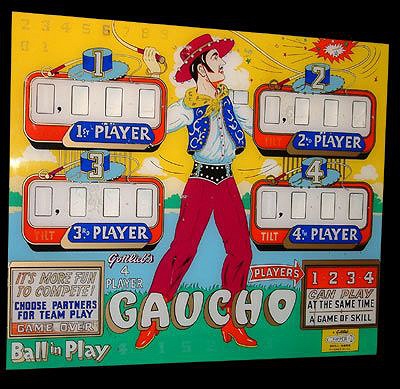
Gottlieb’s 1963 release, *Gaucho*, stands as a quintessential artifact of the golden age of electromechanical pinball, pairing the design prowess of Wayne Neyens with the iconic, colorful brushwork of Roy Parker. Transporting players to the rugged plains of South America, the game leans into an adventurous, mid-century theme that eschews modern flash for the rhythmic, satisfying clatter of relay logic and score reels. With a production run exceeding 5,000 units, *Gaucho* was a staple of the era’s arcades, offering a surprisingly dense playfield layout that forces players to navigate a gauntlet of obstacles rather than relying on today’s complex mission-based rulesets.
The mechanical heart of the board is defined by its dual roto-targets, which act as the primary focal points for high-scoring runs. Surrounding these rotating arrays are five active pop bumpers and four passive bumpers, creating a chaotic, high-rebound environment that demands precise flipper control. Unlike the “shoot-the-ramp” flow of modern machines, *Gaucho* is an exercise in geometry; players must calculate the unpredictable deflections off the passive bumpers to catch the roto-targets at the optimal angle. A well-placed rollunder and a single standup target round out the board, requiring a disciplined approach to keep the ball in play while hunting for the elusive, high-value rotations.
For those looking to master this classic, the strategy is rooted in patience and target management. Because the roto-targets are the central engine for score advancement, the goal is to stabilize the ball in the lower playfield and pick off the targets systematically rather than firing blindly into the bumper forest. By manipulating the rotation of the targets through controlled shots, skilled players can sustain their scoring momentum across all four player slots. *Gaucho* remains a testament to the era’s design philosophy, proving that even with a simple two-flipper setup, a well-balanced layout can provide a challenging and rewarding experience that holds its own against more modern, tech-heavy cabinets.