
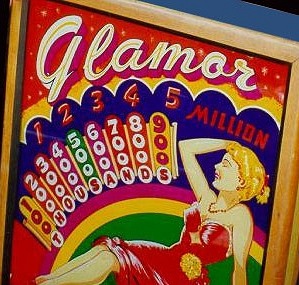
Gottlieb’s 1951 release, *Glamor*, stands as a quintessential artifact of the early post-war era, showcasing the legendary partnership between designer Wayne Neyens and artist Roy Parker. As a single-player electro-mechanical machine, it leans heavily into the aesthetic sensibilities of the time, featuring Parker’s iconic, stylized portraiture that defined the visual language of the decade. With only 300 units confirmed to have left the factory, *Glamor* is a rare, refined slice of pinball history that captures the transition from the woodrail era into a more structured, tactical style of play.
The mechanical layout is surprisingly dense for its age, utilizing a four-flipper configuration that demands precision from the player. While the playfield is populated with a pair of active pop bumpers and eight passive bumpers that create chaotic, unpredictable ball paths, the machine’s most distinctive feature is the safety gate positioned between the flippers. This “save” mechanism acts as a critical buffer, offering a moment of relief in an otherwise fast-paced and unforgiving game. Managing the ball’s trajectory toward the kick-out hole remains the primary path to high-score glory, requiring a disciplined approach to nudging and shot selection.
Tactically, *Glamor* rewards the patient player who learns to manipulate the ball around the passive bumper clusters. Because the game lacks the complex rule sets of modern machines, success here is entirely dependent on mastering the geometry of the four flippers. The safety gate is your best friend, but relying on it too heavily will eventually lead to a drain; instead, focus on consistent, controlled shots to the kick-out hole to maximize your scoring potential. It is a stark, elegant challenge that proves that even in the early days of the hobby, Gottlieb knew exactly how to balance frustration with the pure, addictive allure of the silver ball.