
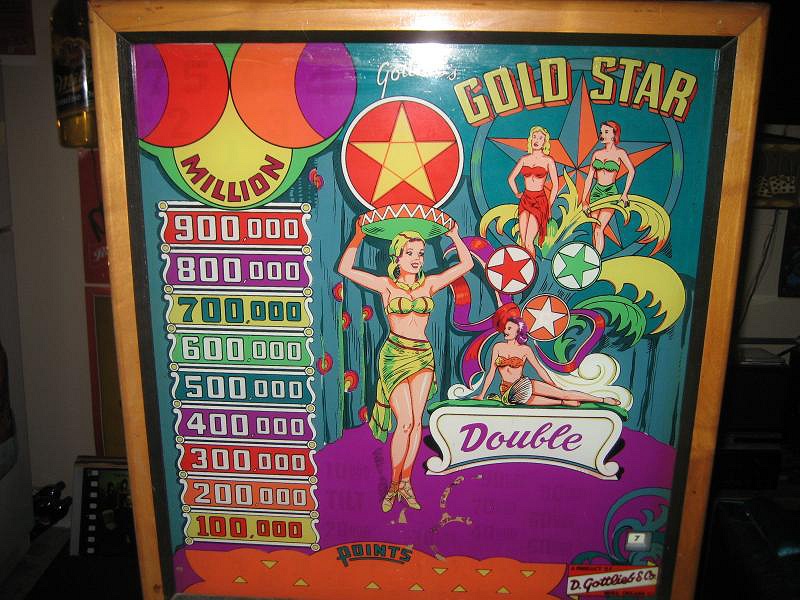
Gold Star, released by Gottlieb in 1954, stands as a quintessential relic of the early post-war era, showcasing the collaborative genius of legendary designer Wayne Neyens and iconic artist Roy Parker. With only 700 units produced, this single-player electromechanical machine captures a bygone aesthetic of pure pageantry. Rather than the complex ramp systems of the modern era, Gold Star relies on the elegant, high-stakes simplicity of its playfield layout, dominated by a cluster of seven gobble holes that demand precision accuracy over brute force.
The mechanical heart of the machine revolves around the interplay between the two flippers and a trio of pop bumpers, which serve to chaos-propel the ball toward the scoring apertures. In an era before digital displays, the game relies on classic light-based scoring to track progress, rewarding the player for navigating the ball into the strategically placed gobble holes. It is a game of patience and finesse; the lack of modern ball-saving features means that every shot into a hole is a permanent commitment, making the experience feel as much like a test of nerves as a test of skill.
For the vintage enthusiast, Gold Star represents the refined transition period of Gottlieb’s mid-century output. Parker’s artwork provides a charming, nostalgic backdrop that complements the straightforward, addictive gameplay. Mastering this machine requires a deep understanding of the playfield’s geometry, as the gobble holes act as both your primary scoring targets and the ultimate destination for your ball. It remains a rare, captivating piece of history for collectors who appreciate the stark, unadorned challenge of early flipper-era design.