
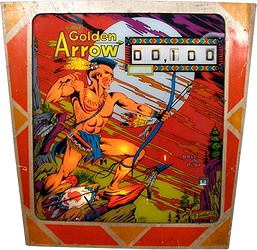
Golden Arrow, released by Gottlieb in 1977, stands as a quintessential example of the late-era electromechanical aesthetic, masterfully crafted by design legend Ed Krynski. With striking artwork by Gordon Morison, the machine leans into a classic Native American warrior theme, delivering a fast-paced, tactile experience that relies on precision rather than digital complexity. Despite its modest feature set, the table’s geometry is pure Krynski, favoring snappy ball movement and rewarding players who can master the rhythm of its spinning targets.
The mechanical layout is deceptively straightforward, centered on a pair of traditional flippers that must navigate a gauntlet of three pop bumpers and two active slingshots. The playfield is punctuated by six standup targets and a pair of spinning targets that provide the primary friction for building scores. Because the game utilizes classic reel scoring, there is an inherent, satisfying weight to every point earned. Success on Golden Arrow demands a rhythmic approach: keeping the ball in motion through the spinners is vital, as these targets provide the momentum needed to reach the bonus thresholds that define high-score play on this era of Gottlieb hardware.
As a single-player experience, Golden Arrow is a test of endurance and focus. While it lacks the flashy toys of modern pins, it captures a specific “golden age” mechanical charm that remains highly collectible today, with fewer than 1,700 units ever produced. For the tournament-minded player, the strategy is classic: prioritize the standup target banks to inflate your end-of-ball bonus, then use the side-feed of the slingshots to ricochet the ball back into the spinners. It is a lean, aggressive machine that proves you don’t need a deep ruleset to deliver an intense, competitive session.