
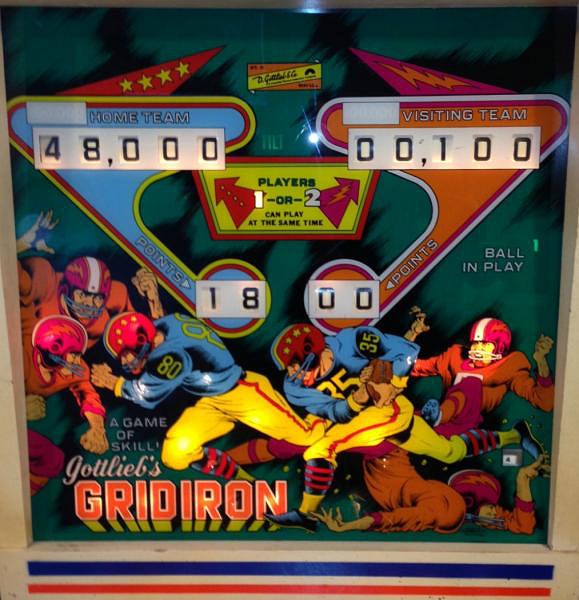
Gridiron by Gottlieb is a rare, tactically demanding electro-mechanical (EM) tribute to American football, designed by John Osborne with striking, nostalgic cabinet and backglass art by Gordon Morison. Released in 1977 with a limited production run of 1,160 units, this two-player, reel-scoring machine captures the gridiron’s grit through a beautifully symmetrical playfield. Osborne’s design is defined by its four-flipper layout, flanked by two pop bumpers and a pair of dynamic Vari-targets—mechanical assemblies that slide backward when struck, measuring the physical force of your shot to award varying yardage and points.
The dual-flipper configuration on both the left and right sides of the lower playfield introduces a tense, high-stakes risk profile. Players must resist the temptation to cradle or trap the ball on the lower flippers, as the treacherous gap between the upper and lower flippers on each side will greedily swallow the ball. Instead, survival demands continuous, rhythmic flipping. The spinning target and the Vari-targets serve as the primary offensive weapons, mimicking the push-and-pull of a real football drive and rewarding aggressive, dead-center strikes.
For tournament players, navigating Gridiron’s quirky scoring rules is the key to victory. The minor one-point standup targets should be actively avoided in competitive play; while they advance your thematic football score, they contribute absolutely nothing to your actual pinball score. Conversely, the game offers a surprisingly forgiving consolation prize on defense: draining the ball through the outlanes triggers a touchdown on the way out, making an outlane exit far more lucrative than a devastating, scoreless drain right down the middle. Gridiron remains a fascinating, highly collectible piece of EM history that translates the physical battle of football into a masterclass of flipper control.