
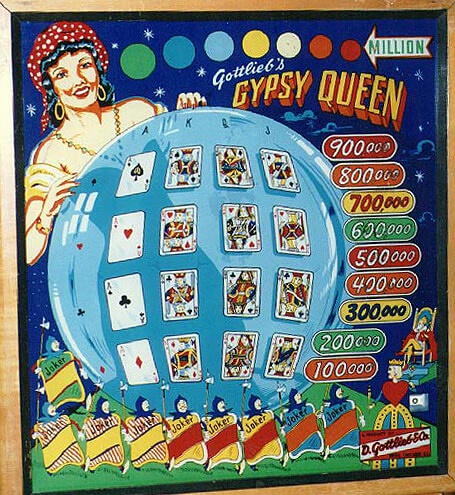
Gypsy Queen, released by Gottlieb in 1955, stands as a quintessential artifact of the golden age of electro-mechanical pinball. Designed by the legendary Wayne Neyens with the unmistakable, whimsical art style of Roy Parker, the game leans into a classic gambling and fortune-telling theme. It is a stripped-back, high-tension experience that relies on the precise geometry of its playfield rather than the bells and whistles of the modern era. With only 1,400 units ever produced, it remains a sought-after piece for collectors who appreciate the stark, challenging architecture of mid-century design.
The machine’s layout is defined by its simplicity, featuring two flippers and a trio of pop bumpers that demand expert ball control. The playfield is anchored by two signature gobble holes—a feature that provides both a thrill and a hazard for the player. Unlike modern machines that reward long ball times, Gypsy Queen forces you to navigate the board with care; once the ball finds those gobble holes, your turn is abruptly terminated. Mastering the rhythm of the pop bumpers to keep the ball in play while avoiding these hungry apertures is the primary challenge of the game.
For those stepping up to the machine today, the strategy is entirely about risk management and flipper discipline. Because the game lacks the complex rule sets of contemporary pins, success is measured by your ability to predict the ball’s movement through the bumpers and steer it away from the gobble holes. It is a test of nerves and mechanical intuition, proving that even with minimal features, Gottlieb and Neyens could create a compelling, high-stakes atmosphere that remains just as demanding today as it was in the mid-fifties.