
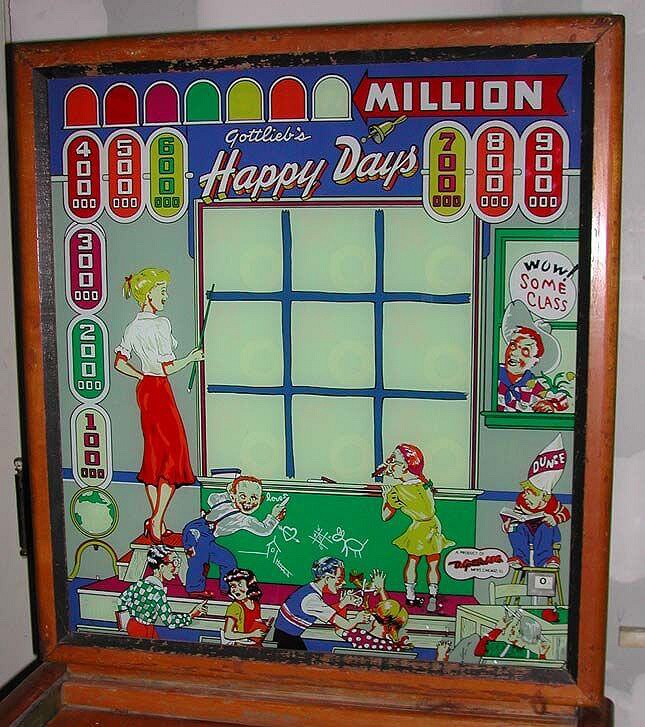
Gottlieb’s 1952 release, *Happy Days*, stands as a fascinating artifact of the early post-war era, showcasing the minimalist charm of designer Wayne Neyens and artist Roy Parker. While the title might evoke nostalgic Americana, the gameplay is an ingenious marriage of education and pure mechanical strategy, utilizing a unique Tic-Tac-Toe theme to challenge the player’s precision. It is a quintessential electro-mechanical machine that eschews modern flash for the satisfying, tactile feedback of a nine-hole grid, demanding a deliberate, measured approach rather than the frantic pace of later decades.
The playfield is defined by its nine trap holes, which serve as the primary targets for completing rows, columns, or diagonals. With only two flippers at your disposal, maneuvering the ball into these specific pockets requires surgical accuracy. The board is densely populated with a gauntlet of ten passive bumpers and two active pop bumpers that act as chaotic interference, frequently ricocheting the ball away from your intended target. The resulting game is a test of patience and geometry, where every successful shot into a trap hole feels like a hard-won victory in a high-stakes classroom exercise.
With only 1,150 units produced, *Happy Days* remains a prized piece for collectors who appreciate the roots of the hobby. The game lacks the complex ball-save mechanics or deep rule sets of the modern era, but it excels in its simplicity. Success here is entirely dependent on mastering the rebound angles created by the passive bumpers and maintaining control over the ball as it traverses the lower playfield. It is a masterclass in space management, proving that even a simple grid can provide a deep, engaging experience if the layout is designed with enough devious intent.