
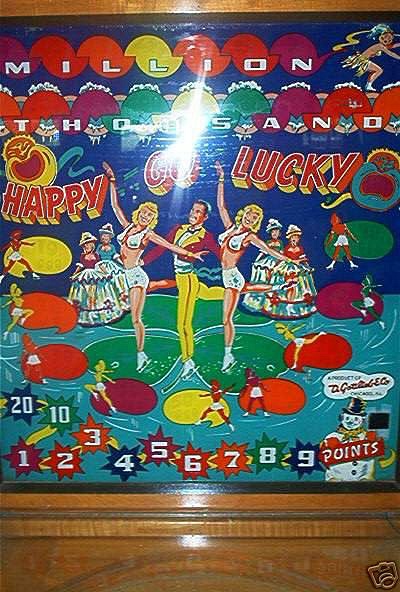
Happy-Go-Lucky, released by Gottlieb in 1951, stands as a charming relic of the early EM era, showcasing the collaborative synergy between legendary designer Wayne Neyens and artist Roy Parker. Centered around the graceful, high-speed theme of ice skating, the playfield captures a vintage aesthetic that prioritizes rhythmic flow over the complex multi-level geometry of modern machines. With only 600 units ever produced, this single-player title is a rare find for collectors who appreciate the tactile, analog simplicity of a mid-century Gottlieb.
The mechanical layout is deceptively straightforward, relying on a pair of flippers to navigate a field populated by two pop bumpers and a quartet of slingshots that keep the ball in constant, frantic motion. Ten standup targets challenge the player’s accuracy, forcing careful aim to rack up scores, while the inclusion of two kick-out holes provides essential ball-save mechanics and scoring opportunities that were highly innovative for the period. Parker’s artwork rounds out the experience, bathing the cabinet in the nostalgic, whimsical style that defined the golden age of arcade games.
For those lucky enough to encounter this machine in the wild, the strategy centers on mastering the rebound angles provided by the slingshots to chip away at the standup targets. Because the game lacks the deep rulesets or digital displays of contemporary pins, success on Happy-Go-Lucky is entirely dependent on touch and timing. It is a pure, unadulterated test of skill that serves as a fascinating snapshot of how Gottlieb transitioned into the early flipper age, proving that even a limited set of features can provide an enduring and competitive challenge.