
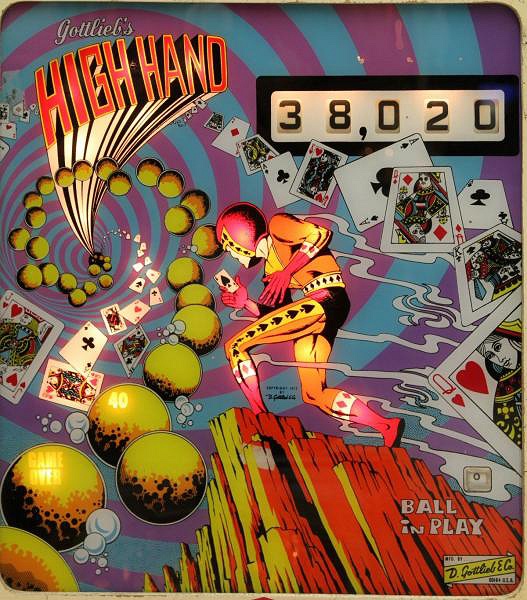
Gottlieb’s 1973 “High Hand,” designed by the prolific Ed Krynski with art by Gordon Morison, deals players into a classic card-themed electromechanical experience. This single-player replay machine presents a straightforward yet engaging playfield, centered around its distinctive card-game objective. Two flippers anchor the bottom, propelling the ball into a landscape dominated by four distinct banks of four drop targets each. A single pop bumper, two slingshots, and a star rollover punctuate the upper field, guiding the ball towards a central kick-out hole, crucial for scoring opportunities.
The heart of “High Hand” lies in its pursuit of poker hands, represented by the four banks of drop targets, each corresponding to a suit of cards. Players aim to clear these banks, collecting “cards” that carry over from ball to ball, adding a layer of strategic accumulation across the game. A well-placed plunge to the lit top lane can immediately net a cool 1,000 points, setting the tone for a high-scoring run. The central kick-out hole becomes increasingly valuable as banks are cleared, offering a significant bonus multiplier for collected suits – a 10x boost from 400 to 4,000 points per card, making it a high-risk, high-reward target.
Mastering “High Hand” often involves a focused approach: players frequently strategize to clear one bank of drop targets entirely before moving to the next, understanding that the center kick-out hole’s value escalates dramatically with each completed suit. While the center scoop offers tempting payouts, its inherent risk makes it a shot for calculated moments. Furthermore, savvy players recognize the critical role of tactical outlane nudging; given that bonus is only collected via the center saucer or the outlanes, skillfully saving a ball from an outlane can be just as crucial as making a high-scoring shot. With nearly 5,000 units produced, “High Hand” stands as a testament to Gottlieb’s enduring EM legacy, offering a captivating blend of card game allure and classic pinball action.