
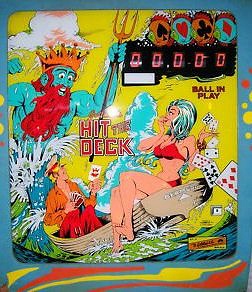
Hit the Deck, a 1970 production from Gottlieb, stands as a quintessential artifact of the late EM era. Designed by John Osborne with striking, vibrant aesthetics by Gordon Morison, the machine leans into a mythological motif that feels like a fever dream of classic arcade artistry. With a limited production run of just 577 units, it remains a coveted piece for collectors who appreciate the tactile, rhythmic satisfaction of reel-based scoring and the straightforward, high-stakes charm of a single-player mission.
The playfield layout is a masterclass in economy, anchored by a pair of snappy flippers that must navigate three pop bumpers and a pair of active slingshots. The flow is punctuated by six star rollovers that demand precise nudging and ball control, while two dedicated kick-out holes provide the primary scoring opportunities. A standout feature for the era is the upper left kickback lane, which adds a layer of defensive urgency to the game—if you can manage to feed the ball into that lane, you gain a vital second chance to keep your session alive.
Mastering Hit the Deck requires a disciplined approach to the game’s geometry; because the machine lacks the complex multiball modes of modern pins, every shot counts toward your final score. Focus your efforts on cycling through the star rollovers to maximize your multiplier potential, as these are the keys to climbing the reel display. The two standup targets serve as your primary risk-reward obstacles, forcing you to choose between safe, controlled play and aggressive shooting. It is a lean, mean, mythological machine that rewards patience and precise aim over brute force.