
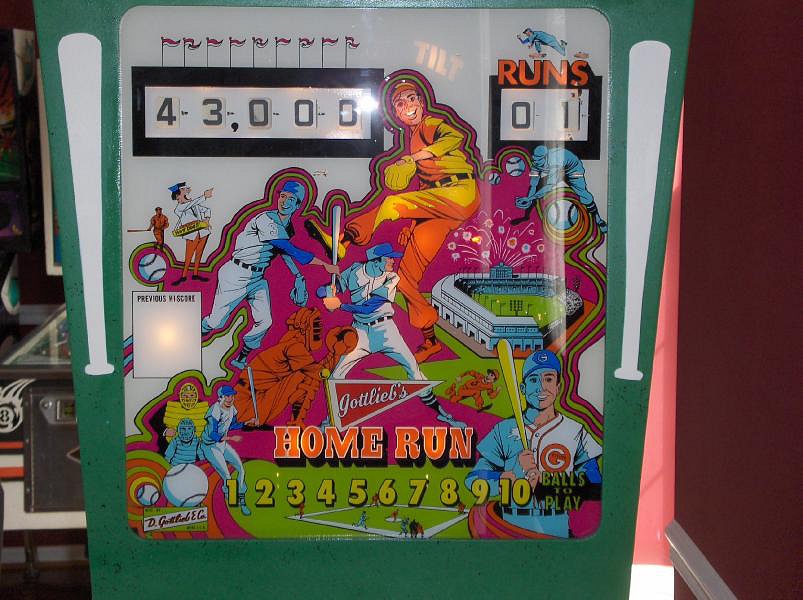
Home Run, a 1954 classic from Gottlieb, stands as a quintessential piece of baseball-themed Americana from the golden age of electromechanical machines. Designed by the legendary Ed Krynski and featuring the sharp, nostalgic aesthetic of artist Gordon Morison, this single-player game captures the simplicity and tension of the diamond. With only 580 units produced, it is a rare find for collectors, offering a distinct departure from modern playfield layouts by stripping the game down to its most fundamental, mechanical elements.
The machine’s most striking feature is its unconventional approach to ball handling: the ball enters the playfield directly from between the flippers, requiring the player to press the right flipper button to set the action into motion. As an “add-a-ball” specialty title, Home Run focuses on sustaining momentum rather than chasing high-score multipliers. The absence of complex ramps or digital displays forces the player to engage deeply with the physical geometry of the playfield, relying on timing and precision to navigate the reels and keep the inning alive.
For those looking to master this vintage gem, the strategy is entirely centered on the rhythm of the playfield. Because the ball is reintroduced through the flipper area, controlling the pace is paramount. Players must treat the machine not as a modern spectacle, but as a test of endurance and mechanical intuition. It is a stripped-back, elegant design that perfectly encapsulates Krynski’s ability to create high-stakes excitement using nothing more than steel, wood, and a scoreboard of spinning reels.