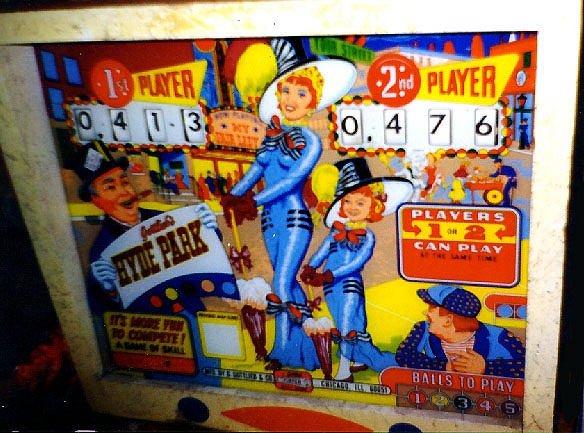
Hyde Park, released by Gottlieb in 1965, stands as a quintessential artifact of the golden age of electromechanical pinball. Designed by the legendary Ed Krynski and featuring the unmistakable, whimsical art style of Roy Parker, this two-player machine transports the operator to London’s most famous green space. With a modest production run of just under 1,000 units, it remains a sought-after piece for collectors who appreciate the tactile, rhythmic satisfaction of an era defined by mechanical relays and physical score reels rather than pixelated displays.
The gameplay is a masterclass in mid-sixties simplicity, anchored by a classic layout that utilizes three pop bumpers, dual slingshots, and a snap target to keep the action unpredictable. As an “add-a-ball” title, the machine focuses on endurance and precision rather than infinite replays; the goal is to extend your session by earning extra balls through skillful navigation of the playfield. The two ball kickers provide necessary momentum to keep the play moving, ensuring that the ball spends as much time as possible in the scoring zones rather than languishing in the outlanes.
Mastering Hyde Park requires a disciplined approach to the playfield geometry that Krynski perfected during his tenure at Gottlieb. Because the game lacks the complex multi-ball modes of modern machines, success hinges on controlling the ball’s return to the flippers and consistently hitting the snap target to maximize point accumulation. It is a contemplative, elegant experience that rewards patience and steady aim, serving as a charming reminder of a time when the world’s most iconic landmarks were captured through the lens of vibrant, hand-drawn cabinet art and the simple, addictive bounce of a steel ball.