
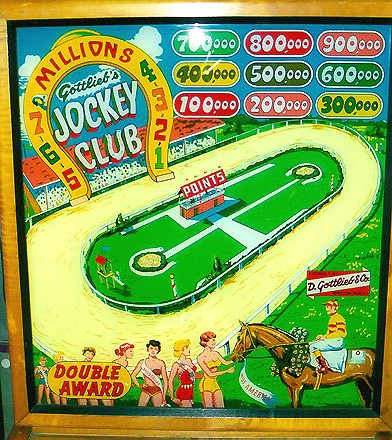
Gottlieb’s 1954 classic, *Jockey Club*, stands as a quintessential relic of the mid-century electromechanical era, showcasing the collaborative brilliance of designer Wayne Neyens and artist Roy Parker. Built as a high-stakes tribute to the world of horse racing, this single-player machine eschews the complex multiball mechanics of the modern age for a frantic, geometry-based challenge. With four flippers at your disposal and a playfield littered with five treacherous gobble holes, the game demands precision rather than raw power. The aesthetic, captured in Roy Parker’s distinct, punchy art style, transports the player straight to the rail of a bustling racetrack, where every bounce off the four pop bumpers or seven passive bumpers could mean the difference between a winning streak and an early exit.
The mechanical layout of *Jockey Club* is a masterclass in risk-reward tension. Those five gobble holes act as the primary drain-points, forcing players to navigate the playfield with a defensive mindset; you aren’t just shooting for targets, you are desperately trying to keep the ball away from the hungry pockets that define the board. The inclusion of two rollover buttons adds a layer of tactical movement, rewarding players who can master the flow of the ball through the upper lanes. In an era where 1,150 units were produced, finding a well-maintained *Jockey Club* today offers a rare glimpse into the design philosophy that favored tight, punishing layouts over the sprawling ramps of later decades. It is a lean, mean, racing machine that remains a testament to the elegant simplicity of 1950s arcade gaming.