
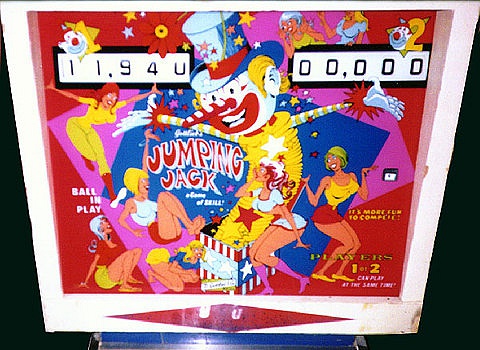
Jumping Jack, the 1973 classic from Gottlieb, remains a quintessential masterclass in Electromechanical design by the legendary Ed Krynski. Featuring iconic cabinet art by Gordon Morison, this two-player machine is defined by its deceptively simple yet punishingly addictive layout. At the heart of the action sits a massive 10-bank of drop targets that demands precision, flanked by two kick-out holes and a pair of strategically placed pop bumpers. With four flippers at your disposal, the game encourages aggressive, rhythmic play, forcing you to constantly navigate the tension between clearing the bank and managing your multipliers.
Success on Jumping Jack hinges on your ability to control the opening move; a savvy player will always aim to plunge directly into the lit saucer at the top of the playfield. Securing that lit saucer is paramount, as it elevates your drop target scoring from a modest 100 points to a lucrative 1,000. If your initial plunge misses the mark, your immediate priority should be to hit the saucer before diving into the targets, especially during the final ball where the point values receive a significant boost. Because the pop bumpers are positioned in a way that can be both volatile and surprisingly helpful, seasoned players learn to rely on subtle nudges to guide the ball toward the opposite saucer, turning a chaotic bounce into a controlled scoring opportunity.
When you find yourself in the zone, the ultimate objective is to chase down the 10x bonus multiplier. Once that multiplier is lit, the game shifts from a casual session into a high-stakes survival challenge. If the ball wanders near the pop bumpers, don’t hesitate to hold the corresponding flipper high; it’s a vital defensive maneuver to prevent the ball from screaming down the center drain. By balancing the pursuit of the 10x bonus with disciplined flipper control, you can master the frantic, mechanical charm that has made Jumping Jack a staple of the classic era for over fifty years.