
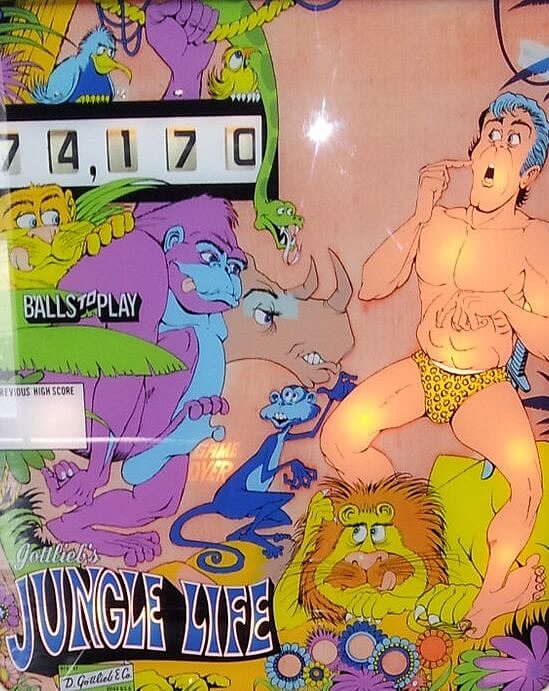
Jungle Life, the 1974 Gottlieb classic, stands as a quintessential example of Ed Krynski’s design mastery during the golden age of electromechanical machines. Featuring vibrant, immersive jungle-themed artwork by Gordon Morison, this single-player title captures the frenetic energy of a wilderness trek. Unlike the high-scoring replay games of its era, Jungle Life was engineered specifically as an “add-a-ball” machine, a design choice that shifts the player’s focus from chasing astronomical totals to the immediate, desperate goal of extending their session through precision shooting.
The playfield is a dense, interactive ecosystem anchored by ten star rollovers and a spinning target that demands constant attention. Navigating the layout requires mastering the interplay between the two flippers and the strategically placed action ring. Krynski equipped the machine with a robust set of recovery tools, including a left outlane kickback to save errant shots and a right outlane return gate, providing a modest safety net for those traversing the dense brush.
For the serious collector or tournament player, Jungle Life is a study in reliability and rhythmic flow. With only 2,731 units produced, it remains a sought-after piece of history for those who appreciate the tactical satisfaction of an add-a-ball mechanic. Success on this table relies on consistent accuracy across the star rollover banks; hitting these targets is essential to keeping the ball in play, as the game rewards consistent, methodical clearing of the playfield over risky, high-power shots. It is a lean, mean, mechanical experience that proves you don’t need digital displays to feel the intensity of the hunt.