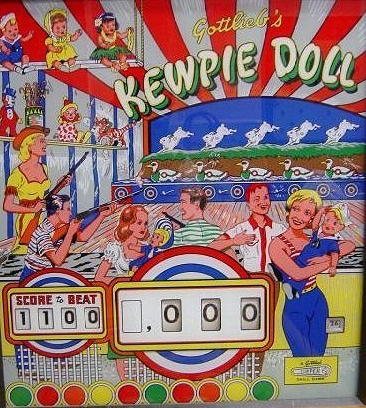
Gottlieb’s 1954 classic, Kewpie Doll, is a masterclass in mid-century carnival aesthetics, designed by the legendary Wayne Neyens with the iconic, whimsical art of Roy Parker. As a single-player electro-mechanical machine, it leans heavily into the “shooting gallery” theme that dominated the arcades of its era. The playfield is a dense, high-tension environment packed with ten standup targets that demand precision, forcing the player to navigate a chaotic layout of three pop bumpers and four passive bumpers that constantly threaten to redirect the ball into the dreaded gobble holes.
The gameplay experience is defined by its unforgiving nature and the distinct “pop” of the era’s mechanical engineering. With only two flippers to defend the bottom of the board, the strategy revolves around managing the rebounds off the passive bumpers while aiming to clear the standup targets to rack up points. It is a deceptively simple game that requires a rhythmic touch; the placement of the two gobble holes acts as a constant pressure point, punishing erratic shots and rewarding the patient player who can control the ball’s trajectory through the cluttered, target-heavy mid-playfield.
With only 950 units produced, Kewpie Doll remains a prized artifact for collectors who value the golden age of Gottlieb design. It captures the charm of a boardwalk midway while delivering the challenging, fast-paced action that defined Neyens’ best work. For the modern enthusiast, it serves as a tactile reminder of why these early machines were so addictive: they didn’t rely on deep software rules, but rather on the raw, unpredictable physics of a ball fighting against a wall of targets and bumpers.