
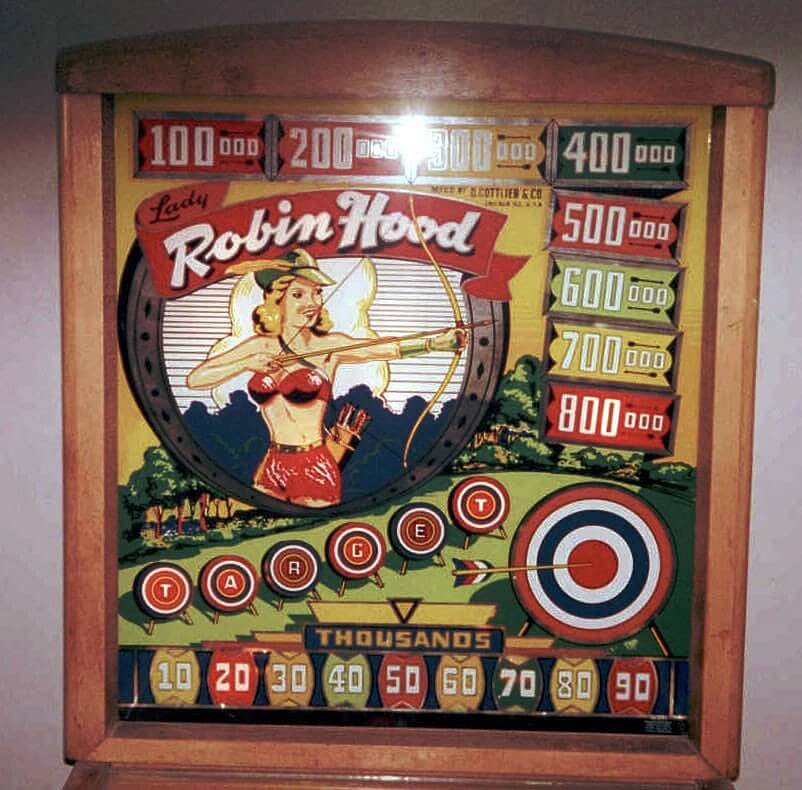
Lady Robin Hood, released by Gottlieb in 1948, stands as a quintessential piece of post-war pinball history, showcasing the artistic and mechanical sensibilities of industry legends Harry Mabs and Roy Parker. As a single-player electro-mechanical machine, it leans into the whimsical folklore of its titular character, brought to life through Parker’s iconic, vibrant illustration style. With a massive production run of 6,000 units, the game served as a staple of the late 1940s arcade scene, challenging players with a playfield layout that feels deceptively simple yet remains a test of precision and timing.
Mechanically, the game is a masterclass in early flipper implementation, featuring a total of six flippers that demand constant attention to keep the ball in play. Unlike modern tables that rely on complex ramps and magnets, Lady Robin Hood thrives on the frantic, reflexive nature of its era; the ball is meant to be nudged and slapped around the playfield toward the single kickout hole, which serves as the primary goal for maximizing points. The design is a testament to the “less is more” philosophy of the time, where the challenge was found in mastering the flipper geometry rather than navigating a narrative-heavy rule set.
For the modern collector or enthusiast, Lady Robin Hood is less about deep-dive strategy and more about the tactile joy of vintage pinball. Success on this machine requires a focus on ball control and learning the specific rebound angles of the six flippers to consistently hit the scoring targets and the central kickout. It remains a beautiful relic of the early flipper age, capturing a moment in time when the transition from purely gravity-fed bagatelle-style games to the high-energy flipper era was in full swing.