
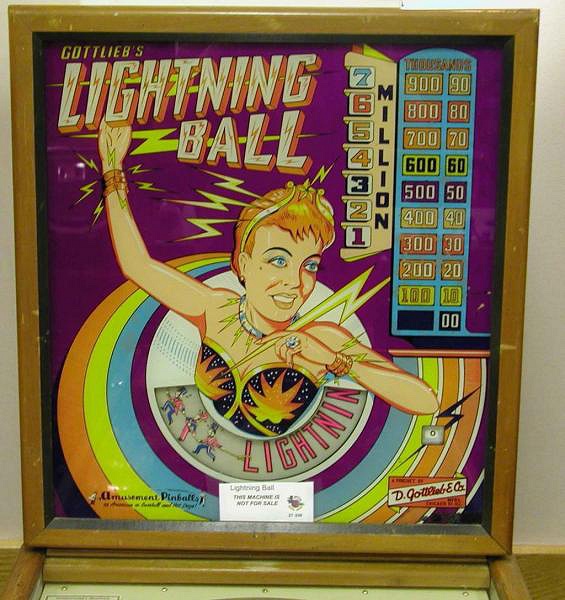
Lightning Ball, released by Gottlieb in 1959, stands as a quintessential artifact of the late fifties electro-mechanical era, showcasing the collaborative brilliance of designer Wayne Neyens and legendary artist Roy Parker. With only 950 units ever produced, this single-player machine is a rare find that captures the minimalist, high-stakes charm of early arcade design. Eschewing the complex multi-ball modes of modern machines, Lightning Ball relies on a tight, unforgiving playfield centered around two flippers and a classic four-pop-bumper layout that demands precision and patience.
The machine’s true visual and mechanical identity is forged through its unique backbox animation, a hallmark of the era that serves as both a scoreboard and a mesmerizing focal point. Beneath the glass, the action is anchored by two gobble holes, which act as both point-scoring opportunities and potential game-enders, forcing players to carefully navigate the ball through three strategic rollover buttons. The interplay between the slingshots and the bumpers provides a frantic, unpredictable pace that defines the “Lightning” namesake, rewarding the player who can master the nudging techniques necessary to keep the ball away from the devouring gobble holes.
For the modern collector or tournament player, Lightning Ball is a masterclass in spatial management. Strategy here is stripped to the bone: because the game lacks the deep rulesets of contemporary pins, success hinges entirely on ball control and recognizing the rhythm of the playfield’s geometry. It is a stark, elegant reminder of a time when the “toy” was the game itself, and the primary objective was simply to survive the lightning-fast rebounds long enough to rack up a high score on the light-up display.