
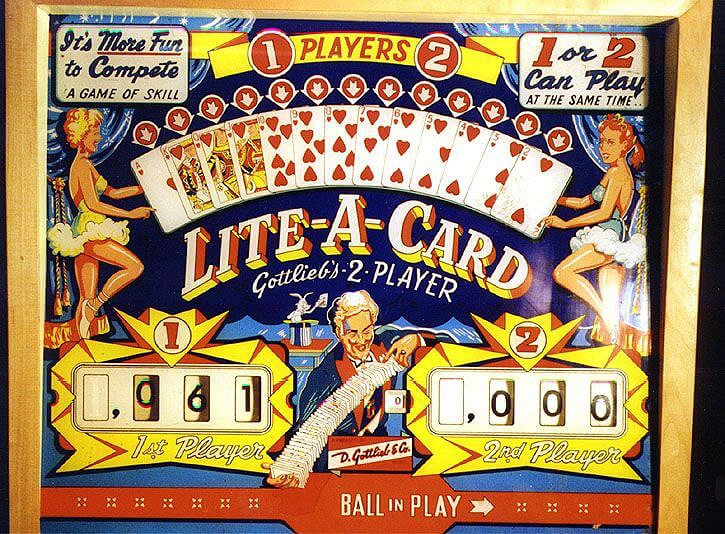
Lite-A-Card, the 1960 classic from Gottlieb, serves as a masterclass in the elegant simplicity of the electro-mechanical era. Designed by the legendary Wayne Neyens with iconic, whimsical cabinet art by Roy Parker, this two-player machine leans heavily into the quintessential card-playing aesthetic of the mid-century arcade. Rather than relying on modern ramps or complex toys, Lite-A-Card challenges the player with a playfield layout defined by its four flippers, three pop bumpers, and a trio of classic gobble holes that demand precision accuracy over brute force.
The brilliance of the design lies in its tactical use of the playfield’s geometry. The bullseye target serves as the centerpiece for skilled shooters, while the strategic placement of the passive bumpers and rollover buttons forces players to carefully navigate the ball’s path to avoid the dreaded gobble holes. With only 850 units ever produced, it stands as a rare, highly sought-after artifact of Gottlieb’s golden age of pinball. It is a game that rewards the patient player who learns to master the subtle nudging required to keep the ball away from the drain and in play long enough to climb the score reels.
For those looking to dominate the machine, success is found in managing the risks associated with the playfield’s open design. Because the gobble holes are hungry for any ball that wanders too close, the key strategy is to utilize the lower flipper pairs to maintain control, steering clear of the center drains while methodically hitting the rollover buttons to build your bonus. It is a quintessential test of skill that strips away the noise of modern features, leaving only the player, the steel ball, and the timeless tension of a high-stakes card game on the glass.