
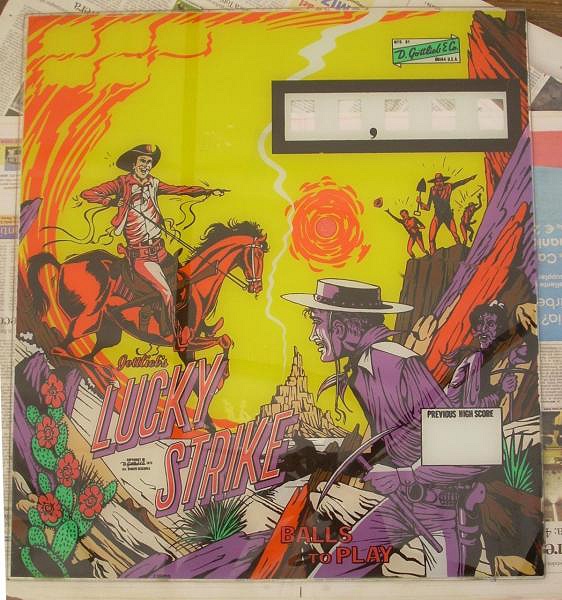
Gottlieb’s 1965 classic, Lucky Strike, stands as a quintessential example of Ed Krynski’s design mastery during the golden era of wedge-head electromechanical machines. Featuring iconic Western-themed artwork by Gordon Morison, this single-player game eschews the standard replay model for an addictive “add-a-ball” mechanic, keeping the tension high as players fight to extend their session. The playfield is defined by an aggressive layout, headlined by a massive 10-bank of drop targets that demands precision shooting and rewards the persistent marksman with significant point accumulation.
The gameplay loop is built on the rhythmic satisfaction of clearing the board, with the 10-bank and a secondary 5-bank of drop targets serving as the primary engines for scoring. Strategy on Lucky Strike centers on managing the lit targets; while standard drops offer a modest 500 points, hitting a target while it’s lit boosts that value tenfold to 5,000. Players must constantly maneuver their shots, using the center rollover or the lower-left standup target to cycle the lighting logic. Mastering the geometry of the four flippers is essential, as the game relies on tight, repetitive shots to clear the banks and maintain momentum.
Despite its age, Lucky Strike remains a tactile challenge that prioritizes mechanical skill over complex rule sets. With only 1,015 units produced, it is a sought-after piece for collectors who appreciate the raw, unadulterated feedback of an EM machine. The game’s simplicity is its greatest strength—it’s a test of focus, requiring the player to constantly rotate the lit target to maximize their score before the ball inevitably drains. It serves as a stark, effective reminder of why Krynski’s designs remain the blueprint for competitive pinball.