
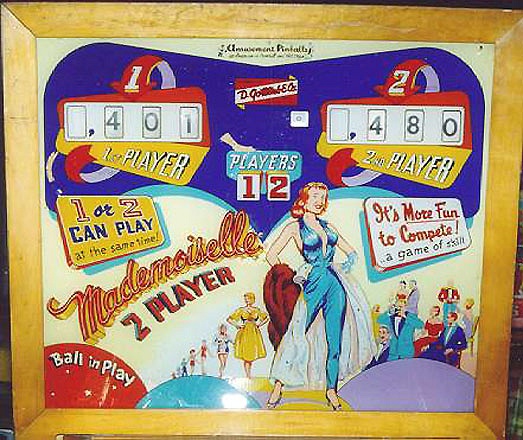
Mademoiselle, released by Gottlieb in 1959, stands as a quintessential artifact of the late 1950s electro-mechanical era, showcasing the legendary partnership between designer Wayne Neyens and artist Roy Parker. With only 700 units produced, this two-player machine is a rare slice of pageantry-themed nostalgia that captures the aesthetic sensibilities of its time. The playfield is a dense, bustling landscape defined by a high-density bumper count, featuring six active pop bumpers and five passive bumpers that turn the ball’s journey into a chaotic, high-energy pinball gauntlet.
The mechanical layout is deceptively simple by modern standards but requires a refined touch to navigate. Players are tasked with mastering a single bullseye target while managing the inherent risk of the two prominent gobble holes that punctuate the lower playfield. Because the game lacks the complex ramps and modes of modern hardware, success on Mademoiselle relies entirely on precision flipper control and the ability to read the unpredictable ricochets generated by the eleven total bumpers. It is a game of rhythm and reaction, where the charm of Roy Parker’s classic artwork perfectly complements the frantic, old-school physics of a machine built for an era when pinball was about surviving the board rather than chasing deep rule sets.