
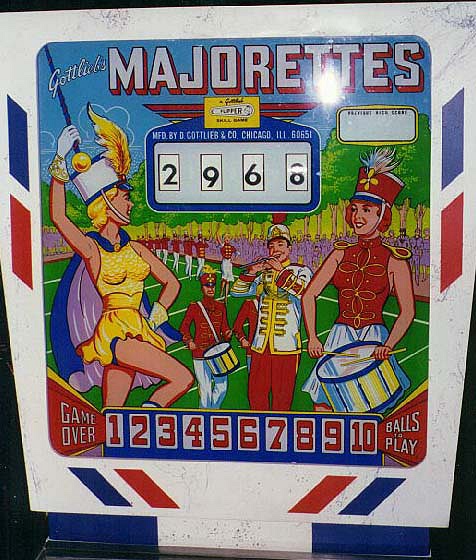
Majorettes, the 1964 classic from Gottlieb, serves as a quintessential masterclass in the “Add-A-Ball” style that defined the era’s competitive landscape. Designed by the legendary Wayne Neyens with iconic, whimsical cabinet and playfield art by Roy Parker, this machine is a rare bird, with only 425 units ever produced. Unlike the high-scoring replay machines of its time, Majorettes focuses on the tension of ball-preservation, rewarding skilled players with extra play time rather than free games, making it a favorite for operators and players in jurisdictions where free-play mechanisms were legally restricted.
The playfield layout is a tight, rhythmic affair that demands precision over brute force. It features a pair of snappy flippers tasked with navigating a field populated by four active pop bumpers and six passive bumpers that act as chaotic traffic islands. The strategic loop revolves around the two kickout holes and a single standup target, which require careful, calculated shots to keep the ball in play. The simplicity of the mechanical design belies a challenging geometry; the rollover buttons and target placements force you to constantly adjust your aim to avoid the treacherous outlanes.
Mastering Majorettes requires a disciplined approach to the game’s unique scoring economy. Since the machine is built specifically for the “Add-A-Ball” experience, your primary objective isn’t just chasing a high score, but maintaining a long-running session by hitting the targets that trigger ball saves. Because the game lacks the complex multiball modes of modern machines, success hinges on your ability to control the ball’s momentum off the bumpers and land clean, repeatable shots into the kickout holes. It is a charming, mid-century relic that proves you don’t need a deep ruleset to find a deep, addictive challenge.