
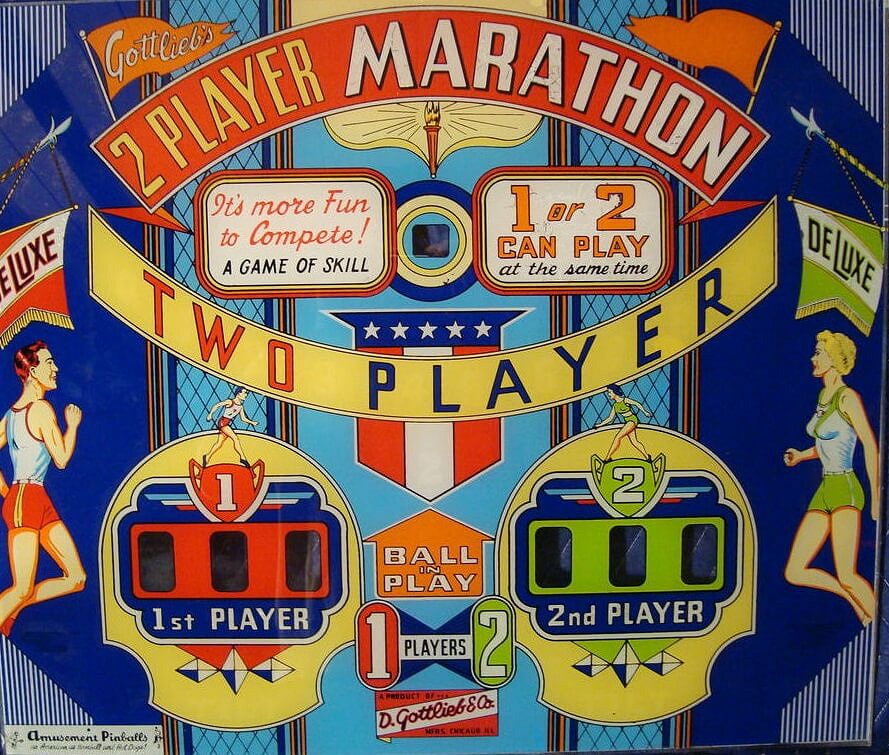
Marathon, released by Gottlieb in 1955, stands as a quintessential artifact of the early electromechanical era, showcasing the collaborative brilliance of designer Wayne Neyens and artist Roy Parker. Centered on the grueling theme of long-distance running, the playfield is a masterclass in mid-century minimalism. Rather than the complex multiball systems of the modern era, Marathon challenges players with a strategic landscape defined by five active pop bumpers and two passive bumpers, all demanding precise ball control to navigate the board’s geometry.
The mechanical heart of the machine lies in its pair of gobble holes, which act as high-stakes gravity traps that define the flow of every match. With only two flippers at the player’s disposal, the gameplay is an exercise in restraint and timing; every shot must be calculated to avoid the hazards while maximizing the scoring potential of the slingshots and pop bumpers. The aesthetic, brought to life by Parker’s iconic illustrative style, captures the vintage spirit of track-and-field athletics, turning a simple game of ball-and-flipper into a test of endurance fitting for its namesake.
With only 750 units produced, Marathon remains a sought-after piece for collectors who appreciate the purity of 1950s Gottlieb design. The absence of modern digital distractions forces the player to engage directly with the physics of the playfield, where the reels click rhythmically to mark your progress. It is a lean, honest machine that rewards steady nerves and careful aim, serving as a reminder that in the world of classic pinball, sometimes the most demanding races are won with just two flippers and a bit of luck.