
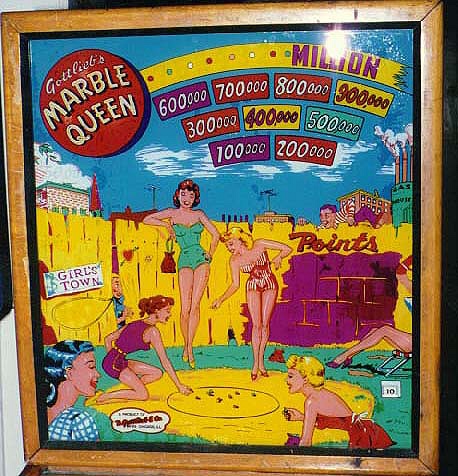
Marble Queen, released by Gottlieb in 1953, stands as a quintessential artifact of the early electromechanical era. Designed by the legendary Wayne Neyens with vibrant, nostalgic artwork from Roy Parker, the game centers on the whimsical theme of a marble-playing contest. Despite its straightforward layout—featuring just two flippers, four pop bumpers, and six passive bumpers—the playfield is deceptively tactical. The centerpiece is the iconic gobble hole, a classic feature that demands precision shooting; sink all five balls into this hungry aperture, and you’ll be rewarded with a hard-earned credit.
Navigating the playfield requires a rhythmic approach to the game’s tiered scoring objectives. You’ll want to systematically strike the pop bumpers in their designated numerical sequence to supercharge the slingshots and the center bumper for massive point bonuses. Meanwhile, spelling out “A-B-C-D” via the rollover lanes is the key to unlocking the Special, lighting up the side lanes for high-stakes excitement. Keep a close eye on the small green rollover buttons as well; they track a secondary scoring system that translates your accuracy into free games.
Mastery of Marble Queen is a lesson in finesse and risk management. While it’s tempting to chase every high-value target, players must remain wary of the notoriously open gaps beneath the flippers, which can turn a potential 500,000-point center drain into a frustrating early exit. Nudging is essential to keep the ball in play, but with the threat of a game-ending tilt always looming, you’ll need a steady hand. It is a charming, challenging piece of history that proves simple mechanics, when balanced perfectly, offer just as much intensity as any modern machine.