
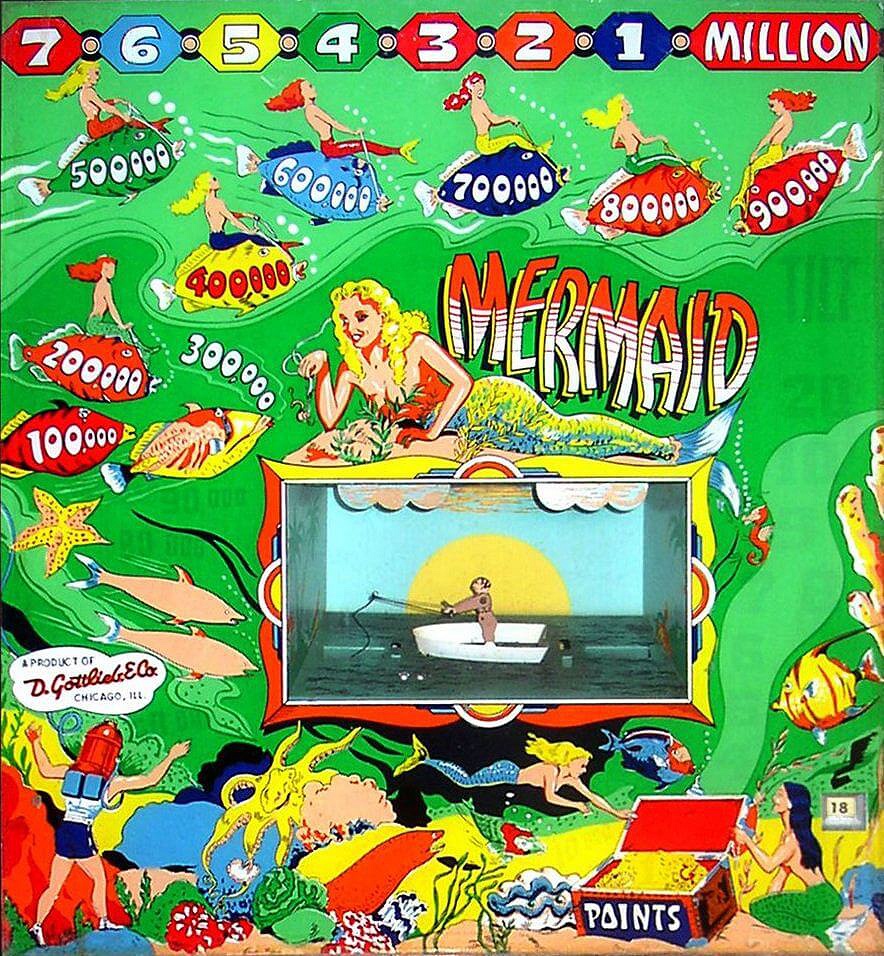
Mermaid, the 1951 offering from Gottlieb, remains a quintessential artifact of the early post-war era, showcasing the legendary collaboration between designer Wayne Neyens and artist Roy Parker. Moving away from the high-octane themes that would dominate later decades, this EM title dives into a serene fishing aesthetic. Despite its modest production run of only 600 units, it is highly regarded for its mechanical backbox animation—a hallmark of the period that turns the score glass into a captivating centerpiece. The playfield is a dense, tactical landscape, ditching the open layouts of its predecessors for a challenging array of three pop bumpers and seven passive bumpers that force the ball into unpredictable, jittery trajectories.
Mechanically, Mermaid is defined by its defensive layout, most notably the iconic V-shaped safety gate positioned directly between the flippers. This feature acts as a physical buffer against the dreaded “drain down the middle,” rewarding players who can master the nudging techniques necessary to keep the ball in play amid the chaotic bumper field. With two active kick-out holes providing reliable scoring opportunities, the gameplay relies on precision rather than raw speed. It is a quintessential “player’s game” that demands patience, standing as a beautiful, kinetic reminder of the era when Gottlieb was setting the standard for backbox ingenuity and tactile, mechanical charm.