
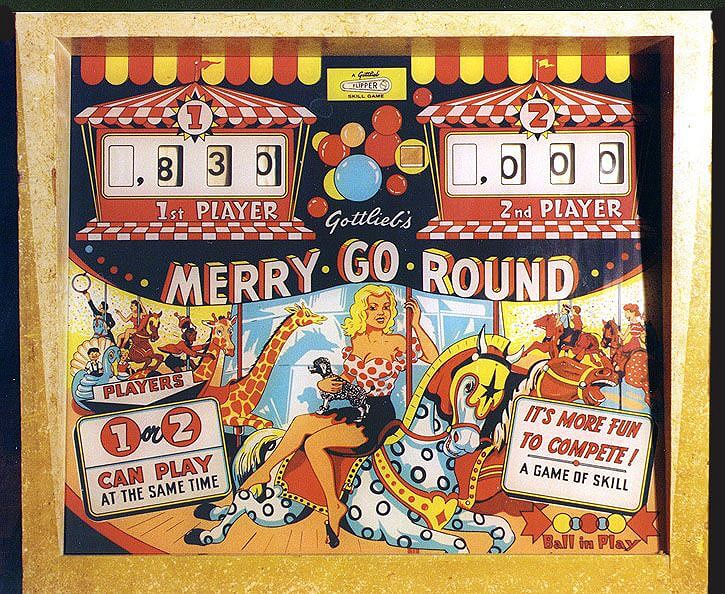
Merry-Go-Round, released by Gottlieb in 1960, stands as a quintessential artifact of the early electromechanical era, showcasing the collaborative genius of designer Wayne Neyens and legendary artist Roy Parker. Centered on a nostalgic amusement park theme, the playfield is a vibrant, uncluttered stage that demands precision over brute force. With its two flippers, three pop bumpers, and a trio of classic gobble holes, the machine captures the charm of a bygone boardwalk, relying on elegant geometry rather than the complex multi-ball mechanics that would define later decades.
The crown jewel of this 750-unit production run is the “Round Robin” scoring disc—a rotating, transparent feature that dynamically assigns point values to the three gobble holes. This mechanical innovation transforms the playfield into a shifting puzzle, forcing players to time their shots to coincide with the most lucrative values as the disc spins. Because the scoring is constantly in flux, the game rewards a rhythmic, patient approach; you aren’t just aiming for the holes, you are playing the clock of the disc itself.
For those looking to master this vintage gem, the strategy relies heavily on managing the rollover buttons to manipulate the playfield’s scoring potential before committing to a shot. With only two players allowed at a time and a reliance on mechanical reels to track your progress, Merry-Go-Round offers a tactile, high-stakes experience where every drain into a gobble hole feels like a gamble against the house. It is a masterclass in minimalist design, proving that a single spinning disc and a well-placed set of bumpers can offer as much tension as any modern, screen-heavy display.