
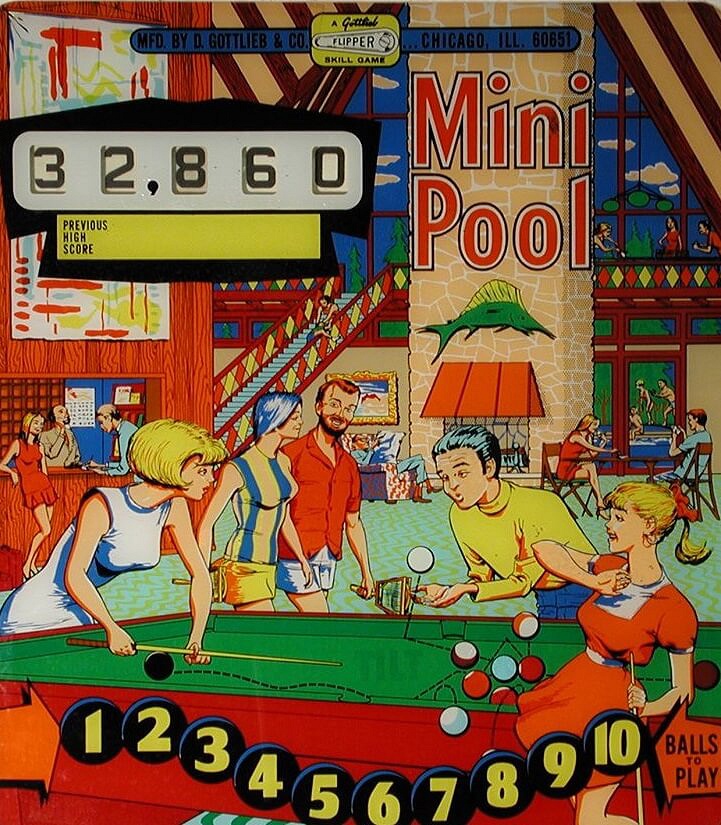
Mini Pool, a 1969 release from Gottlieb, serves as a quintessential masterclass in the “Add-a-Ball” era of electromechanical design. Penned by industry legend Ed Krynski and featuring the classic, clean aesthetic of artist Art Stenholm, this single-player machine translates the tension of the billiards hall onto a crowded playfield bristling with 27 individual targets. With only 500 units ever produced, it remains a rare, compact challenge that demands precision rather than brute force, relying on a solitary pop bumper to keep the action lively as players navigate the dense bank of targets.
The gameplay on Mini Pool is a study in calculated risk. While the temptation to clear the board is high, savvy players learn quickly that the far-left and far-right targets in the front bank are traps; striking them too aggressively often redirects the ball straight into the outlanes, effectively ending your run prematurely. Instead, the path to a high score lies in methodical navigation—working the top lanes to power up the pop bumper for increased scoring, and prioritizing the yellow-lit shots for a 300-point bounty.
To master the board, you must adopt a patient, defensive style. Holding the flipper up while the ball transitions through the inlanes is a vital technique, allowing you to “bridge” the ball across to the opposite side for a more controlled, deliberate shot toward the upper playfield. By focusing on keeping the ball in play rather than chasing every target, you can capitalize on the addictive “Add-a-Ball” mechanic. It is a deceptively simple design that rewards the disciplined player, proving that even a small, classic table can pack a serious punch.