
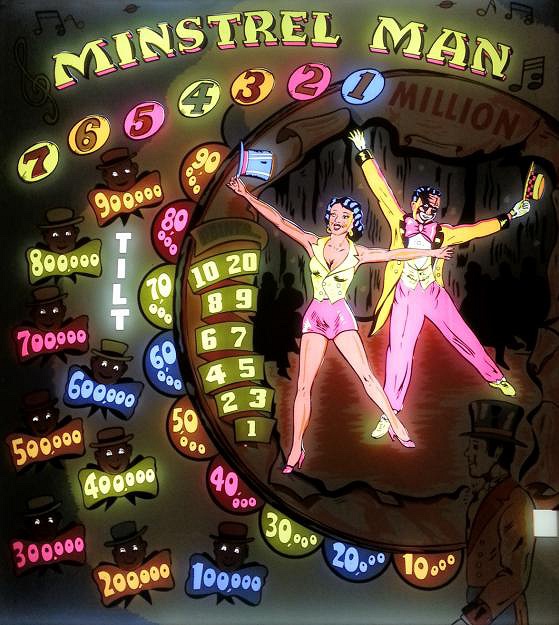
Minstrel Man, released by Gottlieb in 1951, stands as a quintessential artifact of the early post-war era, showcasing the collaborative genius of legendary designer Harry Mabs and iconic artist Roy Parker. As a single-player electro-mechanical machine, it leans heavily into the Americana-infused aesthetic of the time, blending music, dance, and history into a package that feels like a vintage vaudeville show trapped in a wood-rail cabinet. With a limited production run of just 1,800 units, it remains a coveted centerpiece for collectors who appreciate the tactile, rhythmic simplicity that defined the dawn of the flipper age.
The playfield layout is a masterclass in mid-century geometry, utilizing a pair of flippers to navigate a chaotic spread of three active pop bumpers and five passive bumpers. This dense network of obstacles demands precise shooting to trigger the two strategically placed kick-out holes and clear the bank of three drop targets. While the machine lacks the complex digital modes of modern tables, its charm lies in the frantic, unpredictable ricochets inherent to the era’s hardware, turning every ball into a test of patience and reflexive timing.
For those looking to master this historical relic, success often hinges on managing the high-traffic zones created by the passive bumpers. Rather than playing for massive jackpots, the strategy revolves around ball control and setting up clean shots into the kick-out holes to maximize scoring potential. The synergy between Parker’s whimsical, nostalgic artwork and Mabs’ robust mechanical engineering ensures that Minstrel Man remains more than just a museum piece; it is a lively, challenging experience that captures the spirited energy of 1950s arcade culture.