
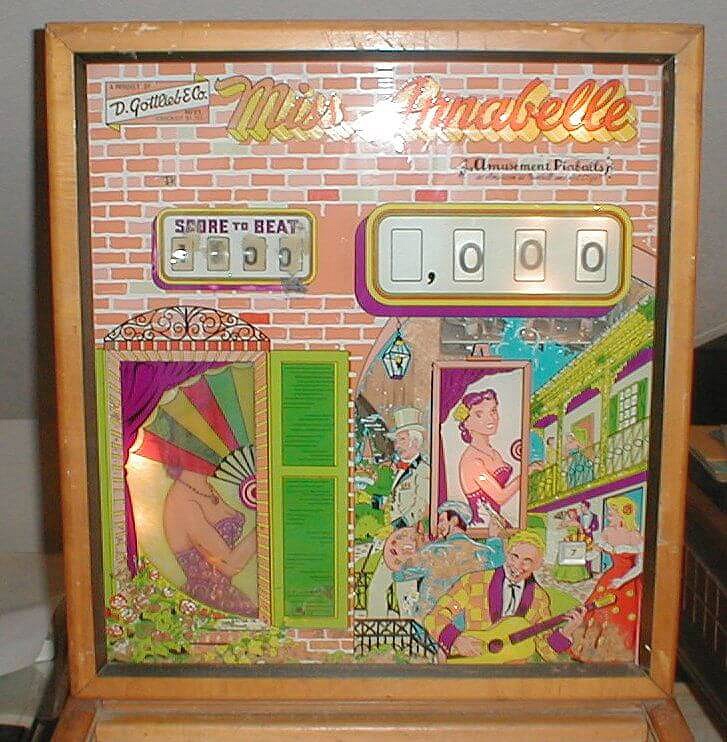
Miss Annabelle, released by Gottlieb in 1959, stands as a quintessential artifact of the late fifties electro-mechanical era, showcasing the legendary collaboration between designer Wayne Neyens and artist Roy Parker. This single-player title captures a whimsical musical theme centered on its namesake singer, brought to life through Gottlieb’s signature charm. With a production run of 1,300 units, it remains a sought-after piece for collectors who appreciate the tactile, analog feedback of reel-based scoring and the artistic flair of classic cabinet production.
The machine’s primary draw is its delightful mechanical backbox animation, which transforms the playfield experience into a performance. Mechanically, the game utilizes a four-flipper layout, providing a wider range of shot angles than many of its contemporaries. Players navigate a field populated by five pop bumpers and two slingshots, demanding precise aim to strike the two standup targets or navigate the ball into the dreaded gobble hole. It is a game of rhythm and reaction, where the lack of modern digital assistance forces the player to rely entirely on the physics of the playfield and the mechanical feedback of the era.
Strategy on a machine like Miss Annabelle is defined by spatial management. Because the playfield centers on a singular gobble hole, the risk-reward calculation is constant; you must balance the aggressive pursuit of high-scoring targets against the peril of a ball-draining pocket. Neyens and Parker successfully merged visual narrative with tight, challenging geometry, ensuring that while the game is simple by modern standards, it remains a test of nerves. For the vintage enthusiast, Miss Annabelle isn’t just a relic—it’s a masterclass in how mid-century designers used mechanical movement to create an engaging, rhythmic experience.