
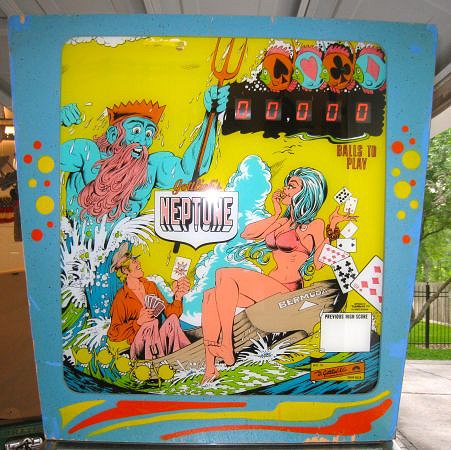
Neptune, released by Gottlieb in 1971, stands as a rare and elegant relic of the electromechanical era. Designed by John Osborne with evocative, aquatic-themed artwork by Gordon Morison, this single-player machine leans into the mythological aesthetic of the deep sea. As an “Add-a-Ball” title, the game prioritizes longevity and precision over the high-score chase, rewarding the player with extra balls instead of free games. With a limited production run of just 286 units, it remains a sought-after gem for collectors who appreciate the tactile, rhythmic charm of reel-based scoring and crisp EM mechanics.
The playfield layout is a masterclass in minimalist design, centering on two flippers that must navigate three pop bumpers and two active slingshots to keep the ball in play. The architecture is deceptively straightforward, featuring two dedicated kick-out holes that test your accuracy and an upper-left kickback lane that provides a vital, albeit unpredictable, save. Because the game focuses on extending your session through ball accumulation rather than credits, the flow is meditative; you aren’t just playing for points, but fighting to keep the ocean from swallowing your ball.
Mastering Neptune requires a disciplined approach to the kick-out holes, as they are the primary drivers of the “Add-a-Ball” mechanic. Rather than relying on power, success on this table comes down to controlled traps and soft, deliberate shots to feed the scoring features. It is a quintessential Gottlieb experience: demanding, beautiful in its simplicity, and perfectly suited for those who prefer the authentic, mechanical click of a vintage machine over the modern chaos of digital displays.