
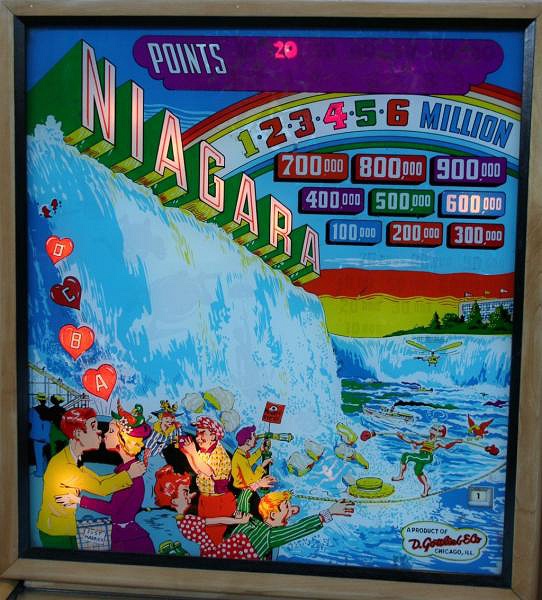
Niagara, released by Gottlieb in 1951, stands as a quintessential artifact of the early post-war era, showcasing the collaborative genius of legendary designer Wayne Neyens and iconic artist Roy Parker. As a single-player electro-mechanical machine, it leans into the serene yet powerful imagery of one of the world’s most famous landmarks. With a production run of only 1,200 units, this title remains a prized find for collectors who appreciate the minimalist, high-stakes charm of early 1950s pinball, where gameplay relied less on complex ramps and more on precision ball control and the rhythmic chaos of a crowded playfield.
The mechanical layout is deceptively simple, anchored by two flippers tasked with navigating a terrain dense with obstacles. Neyens packed the board with four active pop bumpers and six passive bumpers, creating a frantic “pinball” effect that forces the ball to carom unpredictably across the field. The game’s strategic core centers on its four trap holes; mastering these requires a steady hand and a keen understanding of the playfield’s geometry, as these targets act as the primary scoring engines. Parker’s signature art style provides a nostalgic, colorful backdrop, grounding the frantic mechanical action in the classic aesthetic that defined the Gottlieb golden age.