
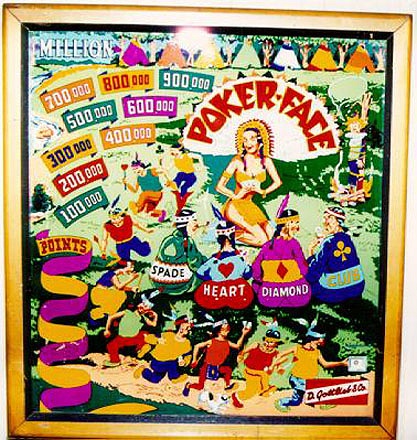
Gottlieb’s 1953 release, *Poker Face*, stands as a quintessential artifact of the early electromechanical era, showcasing the legendary partnership of designer Wayne Neyens and artist Roy Parker. Centered on a thematic departure from standard sports or carnival motifs, the game depicts Native Americans engaged in a high-stakes card match. Far from the complex, ramp-heavy layouts of the modern era, *Poker Face* relies on a stripped-down, punishing geometry that demands precision; it is a game defined by its simplicity and the unforgiving nature of its playfield architecture.
The mechanical soul of the machine lies in its six gobble holes—a hallmark of mid-century design that serves as both the primary objective and the player’s greatest adversary. With three pop bumpers punctuating the center of the board, the ball is frequently sent careening toward these collection points. In an era before complex multiball modes or deep rulesets, the challenge is purely structural: navigating the ball safely past the hazards while aiming for the specific holes required to complete a “hand.”
Because the game lacks the controlled flow of modern flipper mechanics, success in *Poker Face* requires a mastery of nudge-heavy defensive play. With only 1,700 units ever produced, it remains a sought-after piece for collectors who appreciate the stark, minimalist tension that only a classic gobble hole layout can provide. It is a brilliant, monochromatic lesson in pressure, where every shot feels like a gamble and the final score is the only hand that matters.