
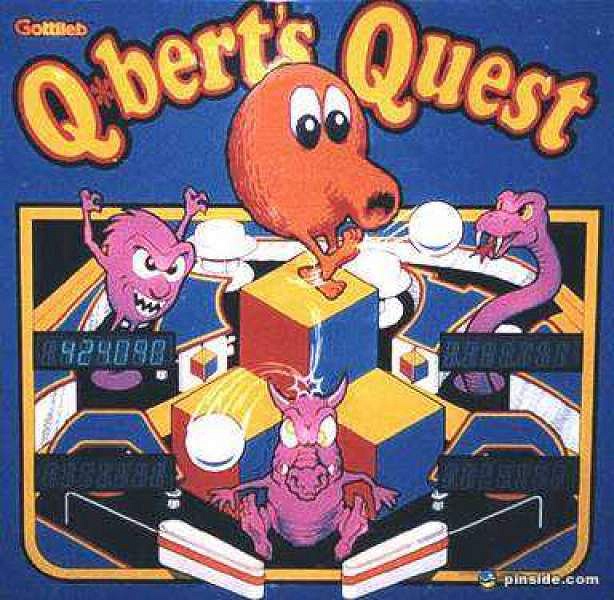
Q*Bert’s Quest, released by Gottlieb in 1983, remains one of the most distinct widebody curiosities from the early solid-state era. Designed by John Trudeau, the table masterfully translates the isometric, multi-level chaos of the iconic arcade platformer into a physical playfield experience. With its expansive, sprawling layout and a quartet of flippers, the game challenges players to navigate a frantic grid of standup targets and drop-bank arrays that evoke the feeling of hopping across Q*Bert’s pyramid, all while backed by the quirky, synthesized audio soundscape crafted by David Thiel and Craig Beierwaltes.
The mechanical design leans heavily into the widebody format to accommodate a dense cluster of seven standup targets and two sets of two-bank drop targets that demand precision shooting to clear. The playfield is punctuated by two kicker lanes that keep the ball in constant, unpredictable motion, forcing players to remain vigilant against the drain. The aesthetic, featuring vibrant cabinet and playfield art from David Moore and Terry Doerzaph, serves as a neon-soaked love letter to the 8-bit golden age, effectively capturing the spirit of a title produced in limited quantities—only 884 units ever left the factory floor.
For those looking to master the pyramid, strategy often hinges on risk management rather than raw power. Savvy players have learned that the high-stakes “snake shot” isn’t always the optimal path; timing out this specific maneuver allows you to concede a single bonus point in exchange for lighting the significantly more accessible right-hand target, streamlining your path to higher scoring potential. It is this blend of arcade nostalgia and tactical nuance that makes Q*Bert’s Quest a prized, albeit rare, centerpiece for any collection dedicated to the experimental spirit of 1980s pinball design.