
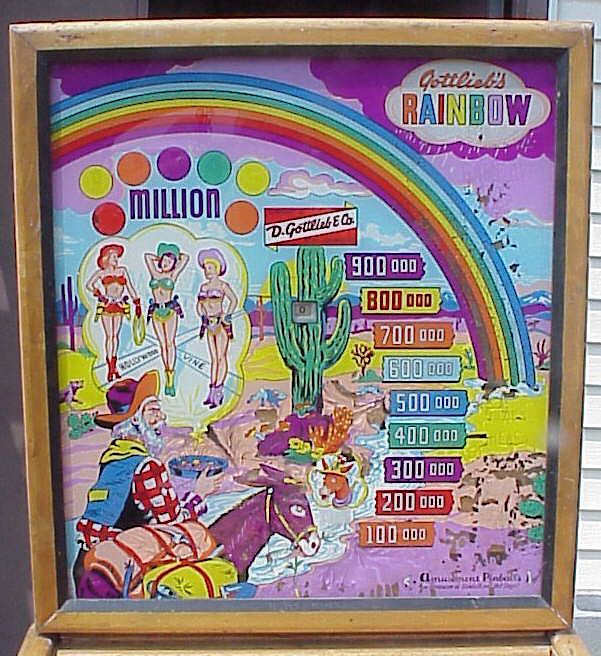
Rainbow, a 1956 classic from Gottlieb, stands as a quintessential artifact of the early electromechanical era, showcasing the collaborative genius of designer Wayne Neyens and legendary artist Roy Parker. While the theme drifts toward the romanticized American West, the playfield is a study in brutal, minimalist efficiency. Eschewing the complex multi-level ramp systems of the modern age, this machine relies on a pair of flippers and a trio of pop bumpers to navigate the ball toward its primary objective: the three notorious gobble holes that define the game’s challenge.
The beauty of Rainbow lies in its scarcity and its unforgiving geometry; with only 1,250 units produced, it remains a coveted piece for those who appreciate the tactile, light-based scoring of the fifties. The gobble holes act as both vacuum and goal, demanding precise aim and steady nerves as players fight to keep their ball in play while chasing high-score thresholds. Because the game lacks the deep rulesets of later decades, success here is entirely dependent on mastery of the flipper timing and an intuitive understanding of the ball’s kinetic energy as it ricochets off the bumpers.
For those looking to conquer this vintage gem, strategy is best distilled into a defensive mindset. Since the gobble holes are permanent point-sinks that end your ball, the most successful approach involves prioritizing ball control over aggressive shots. Treat the pop bumpers as volatile accelerators rather than scoring targets, and learn the specific rebound angles of your machine to avoid sending the ball plummeting into a hole before you are ready. It is a game of patience and poise—a stark, elegant reminder of why Gottlieb’s mid-century output remains the bedrock of the hobby.