
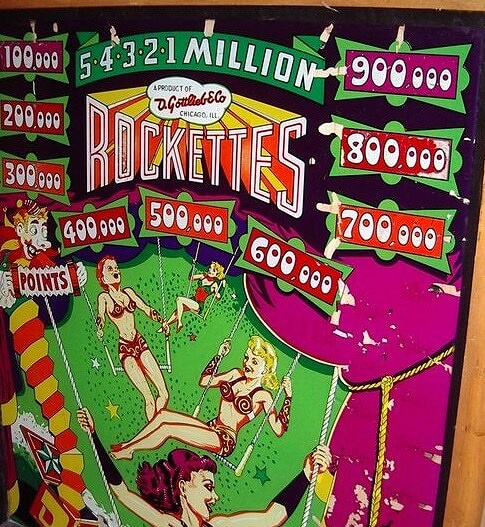
Rockettes, released by Gottlieb in 1952, stands as a quintessential artifact of the early electro-mechanical era, showcasing the collaborative genius of designer Harry Mabs and iconic artist Roy Parker. With a whimsical theme centered on the joy of the circus and carnival, the game radiates the charm of 1950s mid-century design. Mabs, a legendary figure in pinball engineering, outfitted the playfield with a sprawling quartet of flippers, a setup that was remarkably ambitious for its time and demands a different level of spatial awareness compared to the standard dual-flipper configurations that would later become industry gospel.
The mechanical landscape is defined by a dense array of scoring features, including two active pop bumpers and four passive bumpers that turn the playfield into a chaotic, high-action environment. The inclusion of four two-way kick-out holes adds a layer of unpredictability to the game’s rhythm, as these targets frequently reset the pace and force players to constantly adjust their aim to keep the ball in play. With only 1,000 units ever produced, Rockettes remains a rare, highly sought-after piece for collectors who appreciate the tactile, analog feedback of a machine that relies purely on lighting and mechanical switches to track progress.
For those looking to master this vintage gem, the strategy lies in managing the multi-flipper layout to navigate the bumper clusters without sacrificing ball control. Because the game lacks the complex rule sets of modern machines, success in Rockettes comes down to precision shot-making and learning the specific ejection patterns of those four kick-out holes. It is a masterclass in minimalist design, proving that even seven decades later, a well-tuned EM machine with Roy Parker’s vibrant, classic artwork can still provide an addictive and challenging test of reflexes.