
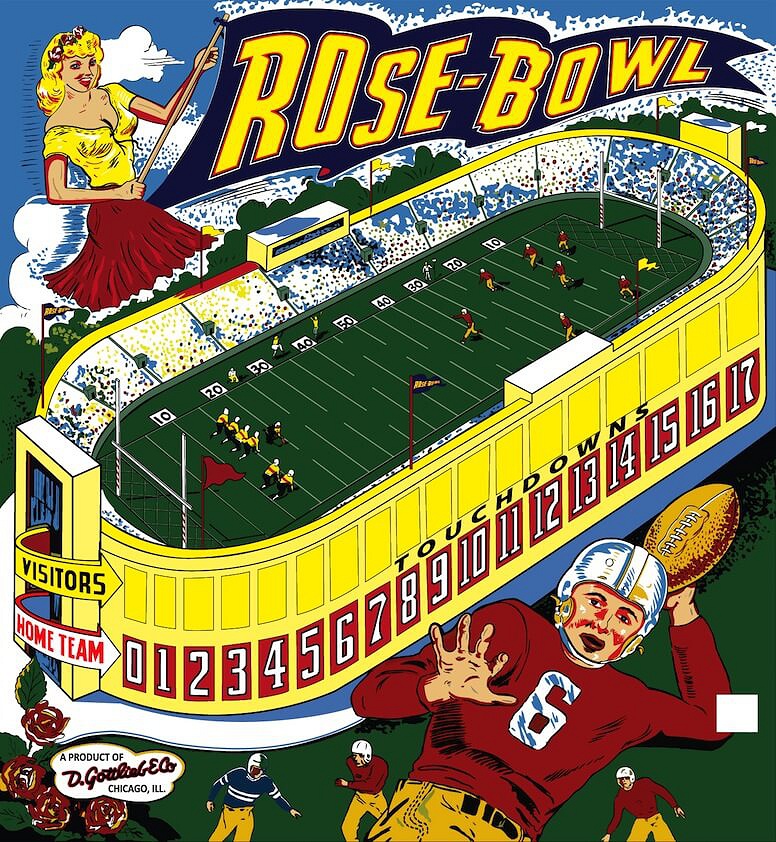
Rose-Bowl, released by Gottlieb in 1951, stands as a quintessential artifact of the early post-war era, capturing the gridiron spirit through the lens of legendary designer Wayne Neyens and artist Roy Parker. As a single-player electro-mechanical machine, it strips away the modern clutter of complex ramps and magnets, focusing instead on the rhythmic satisfaction of pure, tactile gameplay. The playfield is a masterclass in classic design, utilizing a symmetrical arrangement of three pop bumpers and four passive bumpers that turn every ball launch into a frantic, chaotic scramble across the field.
The mechanical heart of the game revolves around its clever scoring geometry, where players aim to navigate the ball through a series of three rollover buttons while strategically utilizing the dual flippers to secure favorable exits. The action culminates at the single kick-out hole, a high-stakes target that rewards precision amidst the unpredictable ricochets of the bumpers. With Parker’s iconic, stylized art package adorning the cabinet, Rose-Bowl feels less like a sterile sports simulation and more like a vibrant, hand-painted snapshot of mid-century Americana.
For the modern collector or tournament player, success on a machine of this vintage requires a shift in philosophy. Without the safety nets of modern ball saves or deep rule sets, the strategy remains refreshingly simple: focus on controlled ball trapping and intentional shots toward the bumpers rather than blind flailing. Because the machine relies heavily on the momentum generated by the passive bumpers, players should prioritize keeping the ball in the upper quadrant of the playfield to maximize scoring opportunities before the inevitable drain. At just 1,000 units produced, this Gottlieb classic remains a rare, essential piece for those who appreciate the foundational mechanics that built the pinball hobby.