
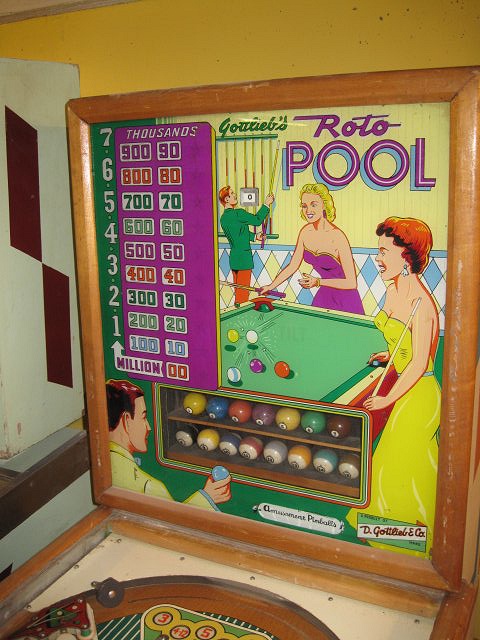
Roto Pool, released by Gottlieb in 1954, stands as a quintessential masterclass in early electro-mechanical design from the legendary duo of designer Wayne Neyens and artist Roy Parker. Built during an era when pinball was evolving from simple bagatelle-style playfields into more interactive experiences, this single-player machine leans heavily into its billiards theme. With its clean, mid-century aesthetic and sharp, challenging geometry, the game captures the tension of a pool hall match, utilizing a pair of flippers to navigate a playfield populated by four pop bumpers and a trio of iconic roto-targets.
The true mechanical hook of the machine lies in the integration of those three rotating targets, which demand precision shooting to cycle through the billiard-themed scoring objectives. Balancing these against the two bullseye targets requires a rhythmic, tactical approach; players must carefully manage their shots to avoid the dual outlanes that flank the playfield. Neyens’ layout is deceptively simple, but the placement of the standup targets creates tight corridors that reward players who can master the momentum of the ball as it caroms off the active bumpers.
With only 1,800 units produced, Roto Pool remains a prized specimen for collectors who appreciate the tactile, analog charm of the 1950s. It lacks the complex mission modes of modern machines, yet it excels in pure, high-stakes arcade competition. Success on this table is less about following a digital rule set and more about reading the playfield’s rebound angles—a testament to a time when designers relied on clever mechanical physics rather than software to keep players coming back for one more rack.