
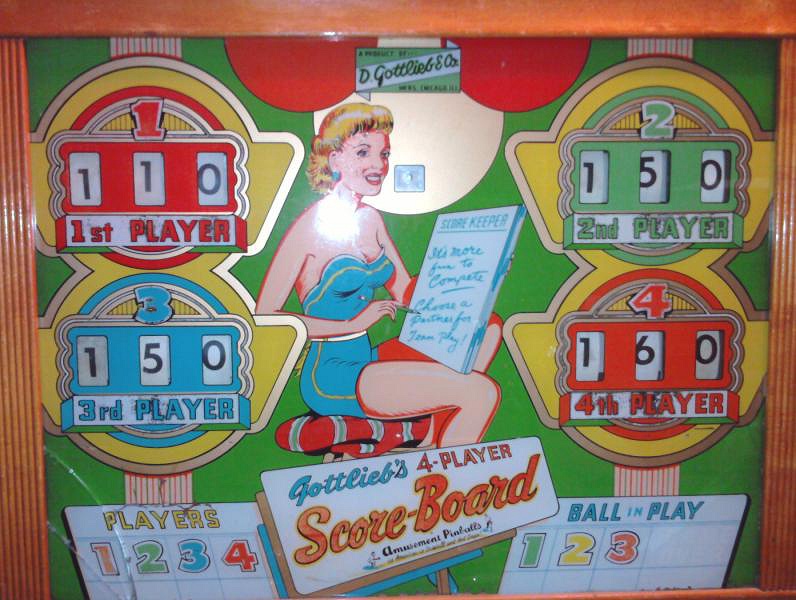
Score-Board, released by Gottlieb in 1956, stands as a quintessential artifact of the mid-century electromechanical era. Designed by the legendary Wayne Neyens with striking cabinet and playfield art by Roy Parker, this four-player machine captures the minimalist, high-stakes aesthetic of the golden age of arcade gaming. Eschewing the complex ramps and magnets of modern machines, Score-Board relies on the pure, chaotic geometry of five pop bumpers and a stubborn passive bumper to keep the ball in constant, unpredictable motion across the playfield.
The mechanical heart of the game revolves around two strategically placed gobble holes, which serve as the primary gravity wells for your ball. Navigating the playfield requires careful management of the two flippers, as the layout demands precise timing to avoid the drain and maximize the potential of the two standup targets. With only 1,300 units produced, it remains a rare, tactile experience for collectors who appreciate the “clack-clack-clack” of mechanical scoring reels and the unfiltered, high-speed bounce of a steel ball rebounding off vintage nylon and wood.
For the tournament-minded player, the key to mastering Score-Board lies in the rhythmic control of the pop bumper clusters. Because the game lacks the deep rulesets of modern software-driven tables, success is entirely dependent on your ability to read the ball’s trajectory as it ricochets off the passive bumper and into the scoring zones. It is a masterclass in spatial awareness; the game demands you treat the flippers not as weapons of control, but as defensive tools to keep the action alive in the upper playfield for as long as possible.