
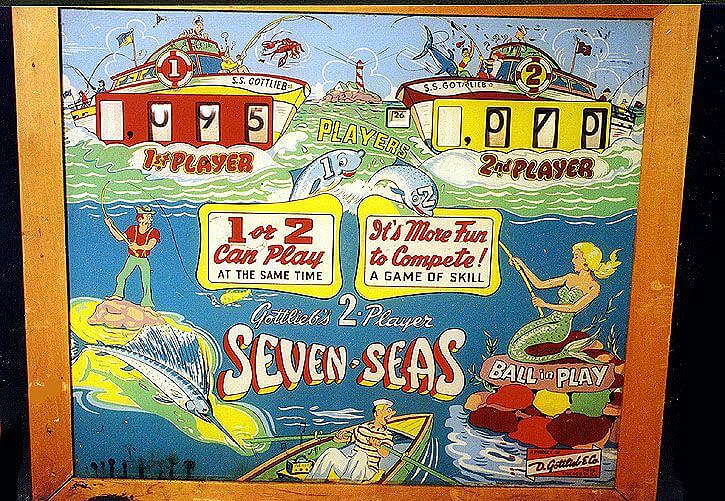
Seven Seas, released by Gottlieb in 1959, is a quintessential slice of mid-century Americana that captures the tranquil allure of deep-sea fishing and maritime adventure. Designed by the legendary Wayne Neyens with the unmistakable, whimsical art style of Roy Parker, this two-player electromechanical machine is a masterclass in vintage simplicity. Rather than the frantic, multi-ball chaos of modern tables, Seven Seas challenges players to navigate a playfield defined by strategic geometry, relying on two snappy flippers to command a board populated by three active pop bumpers, a pair of passive bumpers, and two elusive gobble holes that demand precision accuracy.
The layout is refreshingly focused, tasking the player with mastering the two bullseye targets and rollover buttons to rack up points while navigating the currents of the playfield. Success on Seven Seas requires a rhythmic, deliberate approach; because the game lacks the complex ball-save mechanisms of today, controlling the flow of the ball is paramount. Experienced players often find that finesse is the only way to avoid the gobble holes when they aren’t the primary objective, using the slingshots to manage the ball’s trajectory back toward the center of the action.
With only 700 units produced, this machine remains a rare, cherished artifact for collectors who appreciate the tactile satisfaction of reel-based scoring and the charm of Parker’s classic cabinet art. It isn’t a game of high-tech spectacle, but rather a test of steady nerves and timing. Whether you are aiming for the bullseyes or attempting to thread the needle between the passive bumpers, Seven Seas offers a meditative, authentic experience that transports you back to the golden age of the neighborhood arcade.