
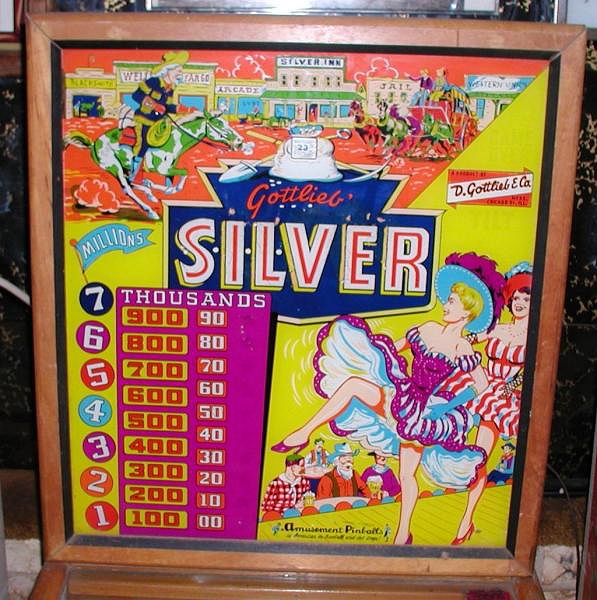
Silver, released by Gottlieb in 1957, stands as a quintessential artifact of the late 1950s electro-mechanical era, showcasing the legendary collaboration between designer Wayne Neyens and artist Roy Parker. Set against the backdrop of the American West, the machine captures the rustic, adventurous spirit of the frontier through Parker’s iconic aesthetic. With a production run of 2,150 units, it remains a sought-after piece for collectors who appreciate the tactile, rhythmic simplicity of mid-century pinball design.
The mechanical layout is a masterclass in classic geometry, anchored by a signature Roto-target that demands precision aim to rack up high scores. Players navigate the playfield using two flippers, maneuvering the ball through a gauntlet of four pop bumpers and two passive bumpers that dictate the frantic pace of the game. Two bullseye targets provide high-value precision shots, while the inclusion of two treacherous “gobble holes” adds a layer of high-stakes risk, forcing players to weigh the danger of a lost ball against the potential for significant point rewards.
Mastering Silver requires a disciplined approach to the Roto-target; because the target face cycles through values, timing your shots to catch the highest point multipliers is the key to besting the machine’s single-player challenges. The combination of rollover buttons and strategically placed slingshots creates a chaotic, unpredictable ball path that keeps the action tight and fast. It is a lean, mean, western-themed experience that prioritizes raw skill over complex rule sets, proving that even decades later, the charm of a well-calibrated EM machine is impossible to replicate.