
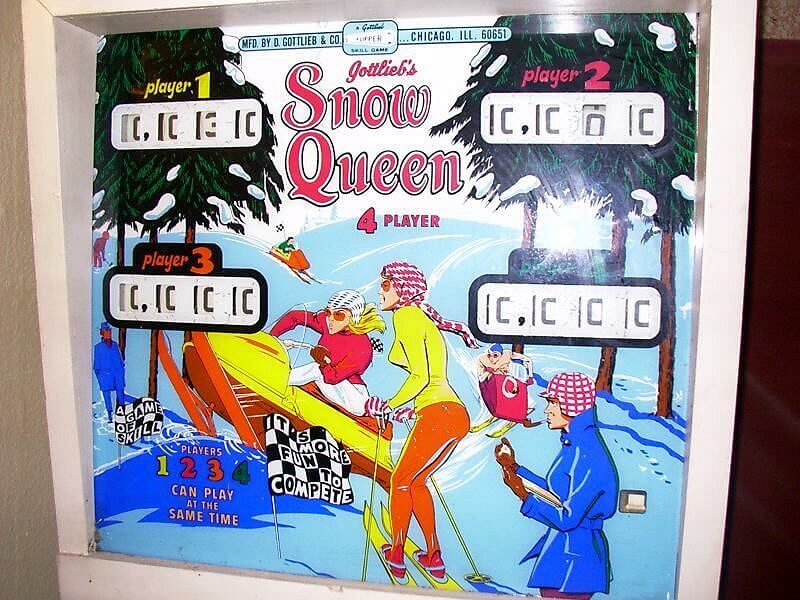
Snow Queen, released by Gottlieb in 1970, remains a quintessential example of Ed Krynski’s design mastery during the transition into the golden age of electromechanical pinball. Featuring evocative, wintry artwork by Art Stenholm, the machine captures the spirit of alpine sports through a playful, four-player format. Beneath the glass, the playfield is deceptively simple but rewards precision, utilizing a symmetrical layout that centers on the thrill of the downhill run. With two snappy flippers, three pop bumpers, and a quartet of kick-out holes, the game demands rhythmic control to navigate the slopes.
The true engine of this machine is found in its dual spinning targets, which serve as the primary objective for any competitive player. These spinners aren’t just for show; they are the fastest way to rack up laps, which in turn build your bonus multipliers. The scoring progression is vital to master: while early balls offer modest rewards for each lap, the value doubles on the fourth ball and quadruples on the final ball, turning the end of the game into a high-stakes sprint for points.
Strategy on the Snow Queen is straightforward but demanding: keep the ball moving through the spinners to maximize your bonus potential before the final ball drain. Because the spinners feed directly into your bonus progression, ignoring them is a recipe for a mediocre score. As a classic EM, it lacks the complex modes of modern machines, but it compensates with that addictive, tactile satisfaction that only vintage Gottlieb mechanics can provide. Whether you are playing solo or in a full four-player match, the game serves as a perfect, chilly reminder of why the “spin-to-win” era of pinball remains a fan favorite.