
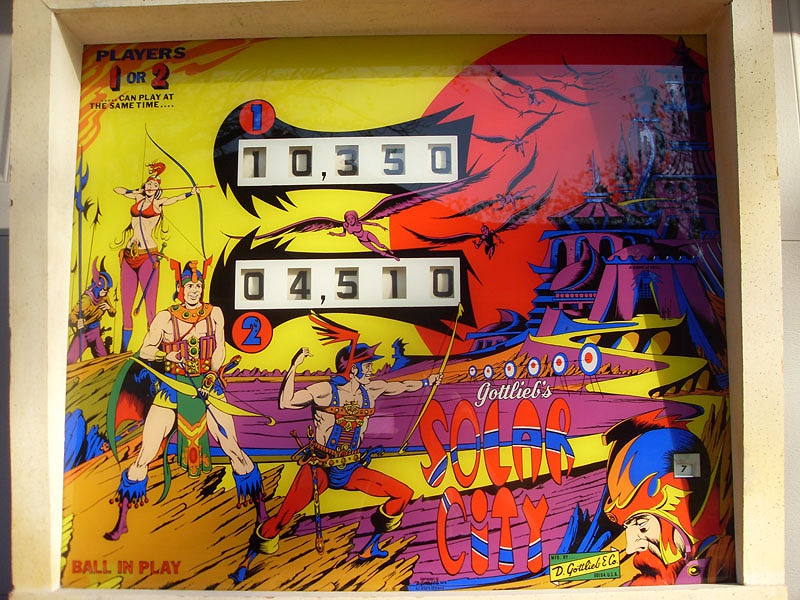
Solar City, released by Gottlieb in 1977, stands as a quintessential example of Ed Krynski’s masterful geometry during the golden age of electromechanical machines. Featuring iconic cabinet and playfield art by Gordon Morison, this two-player title leans into a classic fantasy aesthetic that feels both nostalgic and deceptively simple. Despite its vintage charm, the playfield is deceptively packed, utilizing four flippers and a sprawling array of fifteen total drop targets split between a ten-bank and a five-bank, demanding precision shooting to clear the board and rack up the points.
The core gameplay loop revolves around high-stakes target management. Players must pay close attention to the lit drop target, which shifts in value from a standard 500 points to a lucrative 5,000-point bounty once illuminated. The game encourages constant engagement with the playfield’s geography; the center rollover and the lower-left standup target act as the primary controls for shifting which rollover is currently active. Mastering the flow requires a rhythmic approach to these targets, as neglecting the lit lanes will quickly leave your score stagnant while the ball careens toward the outlanes.
With over 2,600 units produced, Solar City remains a testament to the tactile satisfaction of Gottlieb’s late-era EM engineering. While it lacks the digital flair of the solid-state machines that would soon dominate the arcades, the machine offers a pure, unfiltered test of aim and timing. It is a game that rewards the patient player who learns to manipulate the lit rollovers rather than aimlessly blasting at the drop banks, proving that even a straightforward fantasy-themed table can offer a deep, strategic experience for those willing to chase the high score.