
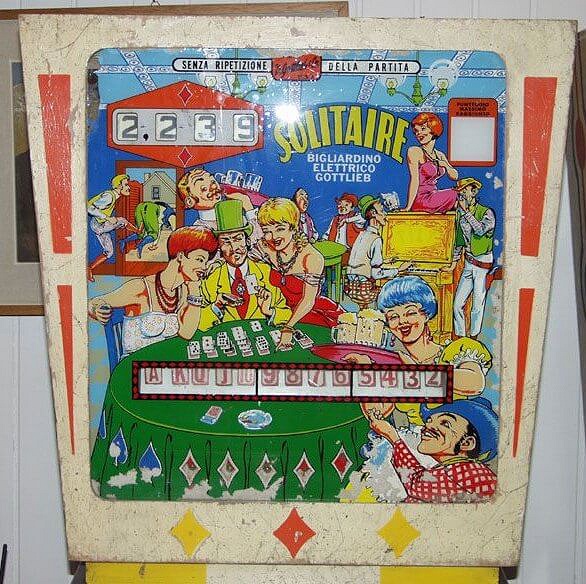
Solitaire, released by Gottlieb in 1972, stands as a quintessential example of the era’s fascination with card-themed mechanics and the high-stakes tension of the add-a-ball format. Designed by the legendary Ed Krynski and featuring the vibrant, classic iconography of artist Art Stenholm, this single-player EM machine forces the player to balance risk and reward across its compact, card-centric playfield. At the heart of the experience is a five-bank carousel roto-target, which serves as the machine’s primary centerpiece, challenging players to navigate the board while avoiding the dreaded drain-prone geometry of its spinning faces.
The gameplay is a study in precision and restraint. While the allure of the center-field action is strong, seasoned veterans know to approach the roto-target with caution; direct contact with the center often invites a swift trip down the middle, while glancing blows frequently steer the ball toward the unforgiving outlanes. Instead, higher scoring potential is often found in the upper reaches of the playfield, where the rollovers and a trio of pop bumpers—surrounded by 50-point standup targets—provide a more reliable, if frantic, path to extending your game.
Because this is a dedicated add-a-ball machine, the objective shifts from chasing massive replay scores to simply keeping the ball in play as long as possible. Success on Solitaire relies on mastering the “long game,” prioritizing controlled shots to the bumpers and top rollovers over the high-risk gamble of the spinning cards. It is a stripped-down, elegant relic of the early seventies that rewards patience and tactical positioning over brute force, perfectly capturing the spirit of a quiet, high-stakes game of cards played out on a hardwood floor.