
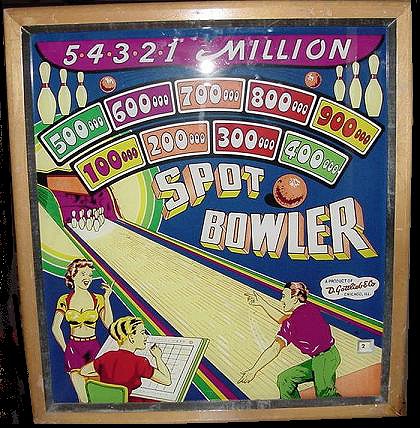
Spot Bowler, released by Gottlieb in 1950, stands as a charming relic of the post-war era when the intersection of arcade gaming and local bowling alleys was in its prime. Designed by the legendary Wayne Neyens with quintessential mid-century aesthetic flair provided by artist Roy Parker, this machine eschews traditional pinball mechanics for a singular focus on the lanes. It is a testament to the simplicity of the early electro-mechanical era, offering a straightforward, one-player experience that captures the tactile joy of knocking down pins without the need for a heavy ball return.
The machine is a masterclass in minimalist design, functioning as a dedicated sports simulator that strips away the complexity of modern multi-ball modes and deep rulesets. With a production run of exactly 1,000 units, Spot Bowler relies on a classic light-based display to track scoring and frame progress, effectively turning the playfield into a digital-analog hybrid of the era. Players are granted five balls for a nickel, an economical price point that invites a quick, rhythmic pace of play.
Because the game lacks the bells and whistles of contemporary tables, success hinges entirely on precision and timing. Mastering the subtle nudges required to steer the ball toward the central targets is essential, as the game demands a consistent, repetitive flow to clear the “pins.” While it lacks the high-octane toys of later decades, Spot Bowler is a prized piece for collectors who appreciate the foundational mechanics of early sports-themed gaming and the distinct, hand-drawn warmth of Roy Parker’s iconic artwork.