
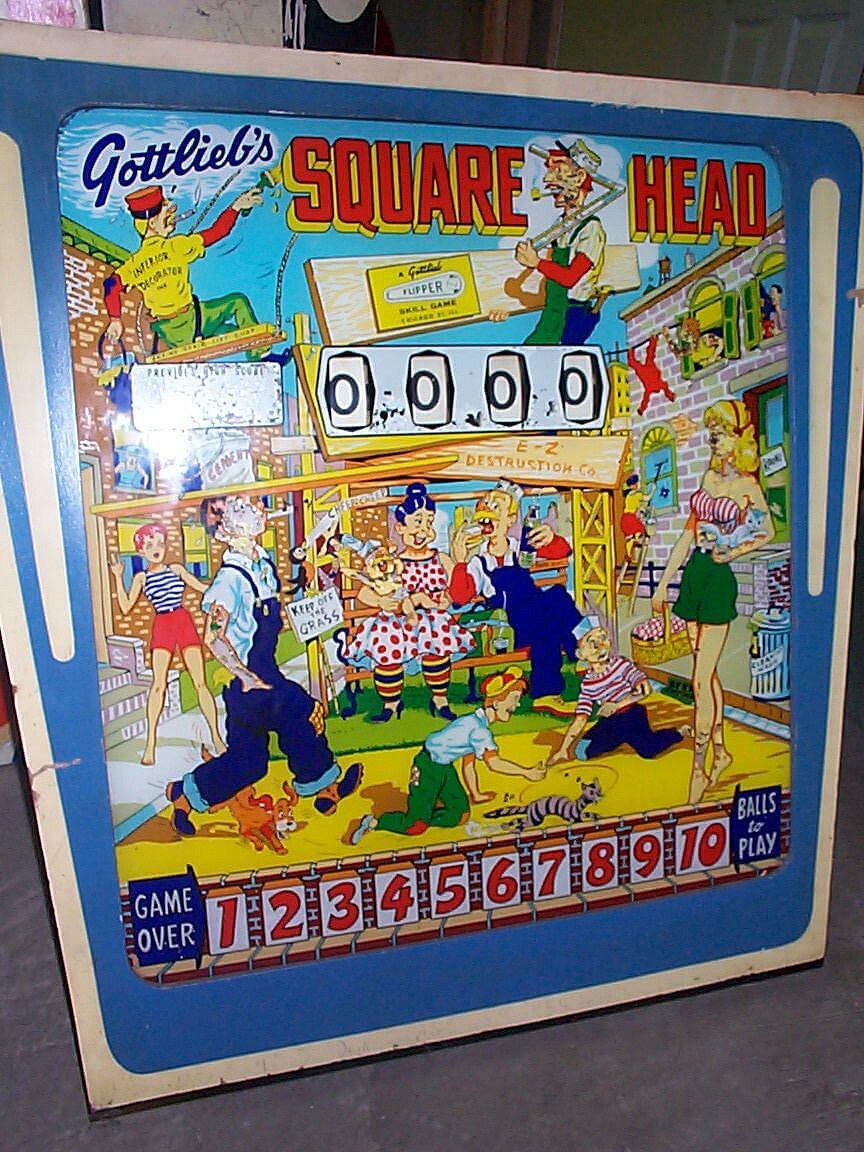
Square Head, the 1963 Gottlieb classic designed by Wayne Neyens, stands as a charming relic of the early EM era, blending the simplicity of a tabletop logic puzzle with the frantic energy of an arcade machine. Featuring iconic mid-century aesthetics courtesy of Roy Parker, the game centers on a Tic-Tac-Toe theme that forces players to balance precision shooting with long-term board management. With its dual gobble holes and a generous array of five pop bumpers and four passive bumpers, the playfield is designed to keep the ball in constant, unpredictable motion, rewarding players who can master the nudging required to navigate its congested layout.
As an “Add-a-ball” machine, Square Head eschews the traditional high-score chase in favor of ball-time survival, a hallmark of Gottlieb’s design philosophy during this period. The objective is to complete the Tic-Tac-Toe grid, a task that demands careful aim at the various targets scattered across the playfield. Because the game lacks the complex electronic modes of modern pins, success here comes down to raw flipper control and anticipating the erratic caroms produced by the passive bumpers. It is a lean, 975-unit production run that captures a specific moment in pinball history where the strategy was as straightforward as the art style, yet the execution remained deceptively difficult.