
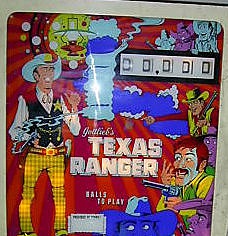
Texas Ranger, released by Gottlieb in 1953, stands as a quintessential artifact of the early electro-mechanical era, showcasing the legendary collaboration between designer Ed Krynski and artist Gordon Morison. Evoking the rugged spirit of the American West, this single-player machine trades modern gimmicks for the tactile, raw satisfaction of high-stakes target shooting. With its classic reel-based scoring and a playfield layout defined by a sprawling array of ten drop targets, it challenges players to clean the board with the precision of a frontier lawman.
The mechanical heart of Texas Ranger lies in its demanding target density. By populating the playfield with ten drop targets and a trio of standup targets, Krynski forced players to master ball control to clear the field rather than relying on chaotic flailing. The two flippers and dual pop bumpers provide just enough kinetic energy to keep the action moving, while the return ball gate offers a strategic safety net for those who can navigate the ball back into the lane. It is a game of rhythm and accuracy, where the simplicity of the era highlights the sheer difficulty of clearing a full bank of targets.
For the modern collector or arcade enthusiast, Texas Ranger serves as a masterclass in minimalist design. Its aesthetic, brought to life by Morison’s evocative art, captures the law-and-order atmosphere of the 1950s without the need for complex subways or motorized ramps. Success on this machine requires a disciplined approach—focusing on singular target banks rather than chasing the bumpers is essential for racking up a respectable score. It remains a stark, elegant reminder of a time when pinball was defined by the clatter of mechanical relays and the singular, satisfying thud of a well-placed shot.