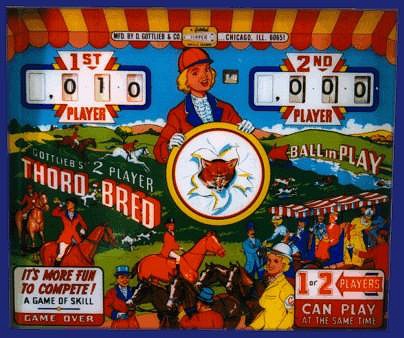
Thoro-Bred, released by Gottlieb in 1954, stands as a quintessential artifact of the early post-war era, showcasing the legendary collaboration between designer Wayne Neyens and artist Roy Parker. Centered on the aristocratic pursuit of fox hunting and horse racing, the game captures the charm of 1950s electro-mechanical design. While modern players might be accustomed to complex ramps and deep rule sets, Thoro-Bred relies on the sheer, kinetic satisfaction of its playfield layout, dominated by a dense array of six pop bumpers that turn the board into a chaotic, high-speed pasture for the steel ball.
The machine’s architecture is deceptively simple yet punishing, utilizing two flippers to navigate a landscape peppered with four standup targets and a pair of slingshots. The “multi-bumper” configuration creates a frenetic pinball environment where the ball is constantly redirected, demanding quick reflexes and a keen eye for the rebound angles that Parker’s vibrant, classic art style hides in plain sight. It is a true two-player test of precision, reflecting the golden age of Gottlieb’s craftsmanship where the focus remained squarely on the rhythm of the playfield rather than digital complexity.
For collectors and vintage enthusiasts, this title serves as a reminder of the industry’s shift toward more interactive layouts. With only 1,750 units produced, finding a well-maintained Thoro-Bred is akin to spotting a thoroughbred in the wild. To master this board, players should focus on controlling the ball’s entry into the bumper garden; because the layout is so bumper-heavy, the key to high scoring lies in managing the initial ricochet patterns to ensure the ball doesn’t drain prematurely through the center, a common peril in Gottlieb’s mid-fifties designs.